The most recent session of The Stories of Our Lives provided a beautiful contrast to the previous one. In June’s session, we discussed the numerous benefits of movement, while this month, we had the opportunity to reflect on the wonders of doing “nothing.” Join us as we delve into the meaningful thoughts that emerged from exploring this seemingly inactive state.
Pauline Omoboye
The art of just being

There’s an art to contemplating
It's not as easy as it sounds
It involves getting in touch with your emotions
Just take a look around.
Are there distractions right in front of us?
We need not make a sound.
Just make our minds totally clear
It’s a miraculous find
We have it lying in our heads
Held there within our mind.
The art of doing nothing is something we all desire
Just switch off and allow it to happen, relight the fire.
The results will make you smile a lot
It’s beautiful to feel
The art of doing nothing
Checks in and makes it real.
So don’t harbour guilty feelings
Its natural to have the urge
Just close your eyes and let it flow
It needs no words.
Jolene Sheehan
As a child, when I didn’t have anyone to talk to, or the capacity to explain myself even when I did, I would make up songs. These songs became a way to express and share how I felt, even when words failed me. It was a form of contemplation, a way to process my emotions by warbling through ”melodies” that emerged. In those moments, I discovered the power of stillness and introspection.
I got much better at sharing my inner musings as time went on. So good that sometimes the abundance of words acted as an approximation of actually connecting with the feelings they were describing. (Funny that). Feeling things and allowing them to flow through me became a challenge. I think there is a vulnerability in acknowledging and embracing emotions, as it means opening myself up to the unpredictability of their intensity. I have come to realise though that this vulnerability is also a gateway to growth and understanding. By allowing myself to feel deeply, I tap into the richness of my fully human experience, even if it means confronting discomfort or pain.
I still feel the challenge of stillness, though it may have changed shape now. Maybe because of the old adage ”the grass is always greener on the other side”? When I don’t have the energy to be busy, I might feel a sense of sadness and label myself as “lazy.” But when I have excess mental energy, it becomes difficult to sit still, to be present and simply do nothing! The challenge it seems, lies in finding balance and appreciating the value of both rest and productivity. It’s about understanding that being busy doesn’t define my worth and that stillness can be just as fulfilling and necessary for my well-being.
Part of finding this balance is acknowledging that our modern environments have become increasingly overstimulating, constantly bombarding us with information, distractions, and expectations. Our nervous systems are on constant alert, making it difficult to truly stop and be present unless we are forced to. We have become accustomed to the strong compulsion to identify as busy individuals, as if our worth is measured by the number of tasks we accomplish. But in this pursuit of constant busyness, we risk losing touch with ourselves and the world around us.
The irony is that in just a few moments of stillness, it becomes clear that our worth is not solely dependent on our productivity, and taking time for contemplation and doing nothing is not a waste but a necessary part of our well-being. It is in these moments of stillness that we can reconnect with ourselves, find clarity, and restore our energy.
Contemplation and the art of doing nothing is not a luxury, but a necessity. It is a practice that allows us to unravel the complexities of our thoughts and emotions, find peace amidst the chaos, and cultivate a deeper understanding of ourselves and the world. It is a reminder to slow down, to be present, and to embrace the beauty of simply being.
Margaret Kendall
“What is this life if, full of care, we have no time to stand and stare” (W.H.Davies, 1871-1940)
When did I first hear the opening lines of this poem? I’ve known it a long time, maybe it was my mum who liked it, or my dad, or indeed both of them? I picture them looking out over one of their favourite views of Derwentwater, relishing their time away from all the stresses of everyday life.
Sitting watching the many bumblebees on the lavender in our garden, bouncing up and down on slender stems that can barely hold their weight, I relax in the sunshine as I drink my tea. It’s a welcome break from the gardening on which I’ve been concentrating. At busier times of my life, it was hard to fit in a break from work, although I often tried to get some fresh air at lunchtime no matter if it was only a ten-minute walk around All Saints Park. I didn’t stand and stare there though! It would have seemed odd in that much-used green space besides the then noisy traffic-filled Oxford Road, full of students sitting together on the grass or rushing to classes on the paths criss-crossing the park.
As I watch the bees, I muse on the fact that we’re never really doing nothing whilst we’re awake, and even asleep, we dream. We’re alive! I’m sitting still; I’m drinking tea; I’m watching the bees; I’m remembering the past; I’m planning to write down my thoughts for Stories of our Lives. What is important though, is to pause, to let the mind wander away, to notice nature and the beauty around us. At night, when my thoughts keep me awake as they often do, maybe it will help to remember feeling my body relax as I sit in the warm sunshine, tasting the tea, watching the bees, hearing their buzz, and smelling the scent of lavender wafting towards me.

Jean Thompson
How interesting and at times moving this session was. So different from the previous session which was all about movement and action. This time we were at the other end of the activity spectrum where the action was all cerebral. One of the dictionary meanings of contemplation is “deep reflective thought” and there was a lot of that expressed in this session. What a great opportunity to be able to express and share our inner selves.
We all had experience of how from childhood, at home and at school, we were exhorted to “go out and play”, “find something to do”, “don’t just sit there doing nothing” and so on. In other words: be busy, be active. Busy, busy, busy.
In adulthood we were again encouraged to be active, busy at work, busy with domestic and family commitments. No time to simply sit and think. As life’s traumas and losses come upon us, it is often good to be busy to stop thinking too much, but then we sometimes miss dealing with those traumas and losses because we are busy simply to avoid thinking about them!
Then we reach the stage in life when we could justifiably sit and think, but still we are told to keep busy, keep mobile, keep those brain cells exercised, try new things. On the one hand that is good advice, but it almost seems as if we are not validated as a person anymore unless we are still busy, busy, busy. We can read, walk, exercise, volunteer for so many things, but can we just sit? Surely at this stage, more than at any other time, we should try to keep a balance between doing things we want to for enjoyment, and doing nothing but thinking. In some cultures, when people get to an older age, and have fulfilled their responsibilities, it is seen as their right to just withdraw and contemplate the world around them and their part in it. Similarly, in some religions it is seen as a worthy use of time to meditate and contemplate.
In this sense is contemplation really an absence of action or more accurately just a different sort of action? More of the mind than of the body? Definitely something to think about.
Shane Murray
I first heard about the Zen Buddhist art of ‘do nothing’ through the writings of Jack Kerouac. This would be the early ‘70s. Kerouac’s style was very appealing to my young self as I loved his strange blend of hip, frenetic ‘spontaneous prose’ and Eastern mysticism. His stories of road trips with fellow poets and drop-outs across the immense, sprawling continent of 1940s and ‘50s America were enthralling. Disenchanted with post war consumerism, they sought alternative experiences – sometimes finding peace and solitude through meditation, climbing mountains or working as Forest Fire look-outs; more often partying hard, experimenting with drugs, falling in and out of love and constantly hitting the road, seeking freedom through endless journeys across America. It’s fair to say that they were Doing Nothing not nearly enough to achieve enlightenment and when Kerouac became famous his personal problems and alcohol abuse were major obstacles to inner peace.

We often leave our youthful enthusiasms behind but I never forgot Keroauc’s wonderful descriptions of his sense of freedom on the road. I’ve done a few road trips with my wife in the last few years. When the talking stops and we turn off the music and the road unfurls before us, the mind gently wanders and the constant noise of my interior monologue pauses for a while. I suppose this is contemplation.
I had a revelation this morning when I realised that I start every day with a contemplation. I get up, go to the toilet, turn on the tap in the kitchen, fill the kettle, and switch on – and while I wait for the water to boil …I look out the window onto our back garden. Same pattern every morning. Sometimes there’s something different to ponder in the garden – a new splash of colour, the first bird or squirrel commanding the lawn. It’s a tiny moment of inner peace. Later, I remember watching my youngest grandson a few days back, rolling pieces of dried pasta back and forth across the kitchen table. The tip of his tongue resting on his lower lip, he rolled that pasta back and forth hypnotically and I watched in a trance. Small moments of peace and unexpected joy. I shall find more of them.
Tony Goulding
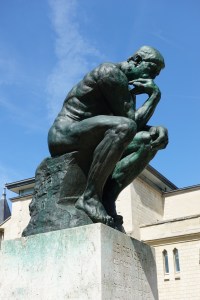
Finding the time to just sit and think seems increasingly difficult as the pace of modern life pressurises us to stay busy. Indeed, moments of deep thought can on occasion be criticised by other people as “daydreaming”.
When I do find the time for deep reflection what often comes to my mind is the realisation that the world does not revolve around me. This thought can be very beneficial in that it induces a more balanced view of life.
At other times I consider the interconnectedness of everything, all life and everything that happens are intrinsically linked. The American mathematician Edward Lorenz developed the concept of a “Butterfly Effect” where a bird flapping its wings in China could result in a hurricane in Cuba. How we are all related to each other is beautifully illustrated in John Donne’s short Poem “No man is an Island” with the closing couplet ——-
 “And therefore never send for whom the bell tolls;
 It tolls for thee."
There are also times when a pause for thought is certainly advisable; as the proverb has it “look before you leap” or, more colloquially, “put your brain in gear before you put your mouth in action”. Also, sports psychologists suggest athletes can improve their performance by spending some time envisaging a successful outcome to their efforts.
Annette Bennett
Good intentions
Today I woke up
With all good intentions,
Full of positivity
Energy
Ideas
Mainly to do some
Spring cleaning.
Make it a priority,
Use my feather duster
To remove those cobwebs
From the ceiling.
Move furniture around
Have a change.

Get the vac out
And reach those
Biscuit crumbs
Sweet papers
Pet treats
That have fallen
Under the seats,
Probably been there
For months.
Maybe find that fiver
Aunt Claire
Lost last year!
Allay her fear
The dog had chewed
And swallowed it!
Plan to tackle
Every room
With enthusiasm
Gusto
So each looks
Tidier hopefully
Even a little bit.

Then knock knock
My neighbour calls
You must come
Round now to my
Coffee soirée
Everyone is there.
Before I know it
The morning has gone by,
Oh bother!!
It’s time for a lunch break
After all
It is approaching
One o’clock
Well past noon.
Sustenance I must take
Keep my strength up
For an active
Afternoon ahead
Return to my agenda soon.

Refreshed here I go
Duster and polish
In hand,
Where shall I start?
The phone rings
It’s my friend
Calling to catch
My latest news.
I put down
My things,
Sit in my favourite
Armchair,
Begin to chat,
Ah well
That is that!
How time flies
I have been
Really busy!!.

I look at my watch
Must make a start
On the meal
The family will
Be home,
But first I need
A cuppa,
A moment or
So to steal,
All that talking
Has made me thirsty
And tired
Not house work inspired!.

Evening arrives,
I can’t possibly
Do anything now
Other than relax,
Watch my
Favourite soaps
On the telly
Chill out!
See what the latest
Storyline is about,
With the cat
Curled on my lap
Purring away.

But hey ho
Never mind
I suppose my
Good intentions
Will keep
For another day.
That is what I say.
I feel sleep
Filling my eyes,
What if I
Woke tomorrow
With different thoughts,
A new view point!
To make a special
Effort to spend time
Perfecting the art
Of doing nothing.
That sounds
Absolutely great,
In fact
I would definitely say
I have made
A very positive start today!!!.

 The Stories of Our Lives