Photographs are tangible records of past moments, precious in so many ways. In our meeting, we shared our thoughts about photographs special to us, the powerful memories they stir and the pleasure we get from taking them. We’re pleased now to share our words and images with you.
My parents treated their photographs in the same way as important documents, storing them in a metal biscuit tin to keep them safe from the risk of fire. That was until snaps were easier to take, albums were filled, and my Dad moved on to taking slides for their superior quality of capturing light and colour.
I still haven’t been able to part with my parents’ precious biscuit tin, although my siblings and I have shared out the photographs or made enhanced copies of them for us all to keep, some in those photobooks you can now create and order online. It’s amazing how well old black and white photographs can be reproduced in digital form, whereas the old colour ones from the 1970s have faded or turned orange and need much more intervention to resemble how they originally looked.
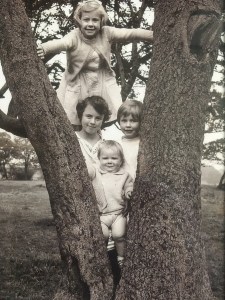
The biscuit tin was popular with my sisters’ and brother’s children when they came to visit. My Mum in particular enjoyed seeing their laughing reactions to early photos of their parents. This one of the four of us when we were out on a country walk with our parents amuses me: I’m the one up the tree despite having a bow in my hair and wearing a dress. I loved climbing trees and being outdoors, but it wasn’t till later that we girls wore stretchy “trews” with straps which went under the soles of your feet.
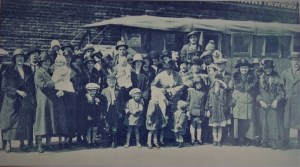
Some photographs were too precious to be handled by the grandchildren. My Mum treasured this photograph of a charabanc outing and wrote down for us the names of her aunts, uncles, cousins and family friends from her childhood. She was one of the toddlers in the picture.
Now that I’m interested in researching family history, it’s fascinating to me to see the only images we have of some of her large wider family.
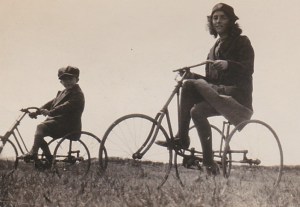
It was only after his death that we discovered early photographs of my Dad and his sister, taken by his father in the 1920s, hidden away for safekeeping. I’d heard my Dad’s stories of my Grandad’s interest in technology, including crystal radio sets and photography, but it was wonderful to see captured moments of happy times they shared.
Jean Thompson
I am old enough to appreciate the printed photo kept safe in an album, of which I have so many, rather than all those stored on the cloud. I am never quite sure where this cloud is but I am assured I have it on my technology!
The albums tell the story of my life, or a good part of it. When I was a child we did not have a camera so the photos of us as children were few and far between taken by relatives who were fortunate enough to own a simple Box Brownie. Even then the occasions we were photographed were seen as a bit special so we were dressed in our clean and tidy clothes. Not for us were the candid shots of children with dirty knees or chocolate covered mouths.
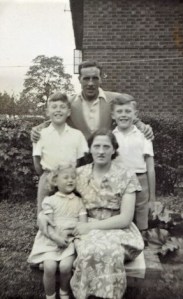
Here is a family photo of mum and dad, my two elder brothers and me in an aunt’s garden. They had a camera! All looking very tidy. Probably about 1952.
One of my favourite photos of the dozens and dozens of my children was taken when my son was about 6 or 7 and my daughter two years younger. We were on holiday at a caravan park. My son had made friends with two other young boys and in this photo the three boys were striding out, off to find an adventure probably. At that age a younger sister was something of liability and the boys are obviously trying to get away from her. But my daughter was never to be ignored or relegated to a role of docility and in the photo she is striding after them determined that whatever fun they were going to have, she was not going to miss out. It is such a picture of who she was then and would ever be. Determined and independent.
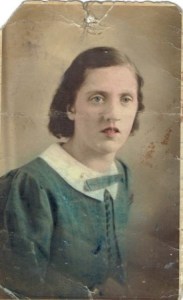
Another poignant photo I found when my mother died. I discovered quite a few photos of family members long gone that she had never shown me and it was a real regret that I did not know who some of these people were. But there was one I found which was special. It was of my mother as a young woman, hand coloured at a later date I guess, but what was special was that in the top was the mark and impression of what I think was a drawing pin. I don’t know the truth of why it had been pinned up but I like to think that my father had pinned it up by his bunk when he was in the army during the war. I wish I knew.
On the back of the photo you can see very faintly the name of the photographic studio, Jerome, and the date 1939. Mum would have been about 24. If you look carefully, you can see the drawing pin hole in the top middle of the photo.
Joyce Lindley
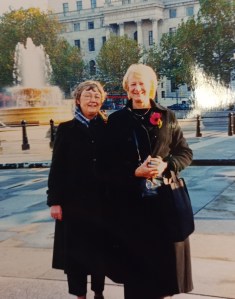
My friend’s father died as a submariner in the 2nd WW. She started to go to the Remembrance Day ceremonies in London as a relative in later years and I accompanied her on a few occasions. I think this photograph of us together in Trafalgar Square was in the 1980s.
It was extremely moving to take part, especially to see the dignity, strength and determination of the older veterans and to think how they had carried on after many traumatic experiences in their lives. I was inspired to write these verses afterwards. We are both in our eighties now and live far apart but still are very close as we have known each other since we were 12 years old at school together.
REMEMBRANCE SUNDAY

The clock struck the hour below heaven's blue skies
And here, in the hush,
Reflected in eyes
That had been through hell's door
I saw sorrow and pride for the fallen of war.

The crisp falling leaves of the tall Whitehall planes
Softly descended like comforting rain.
And here in the centre of London's great heart
We stood and we honoured all those who took part
In the sorrows and conflicts
It seems will endure
For as long as mankind needs to solve things
By war.

Lay the wreaths and the flowers,
Blow the last post out loud.
Fire the cannons saluting this heroic crowd
And pray that all children
Will grow in the sun
Of freedom's pure light, not the shadow of guns.

(Composed 2007).
Pauline Omoboye
Behind the lens

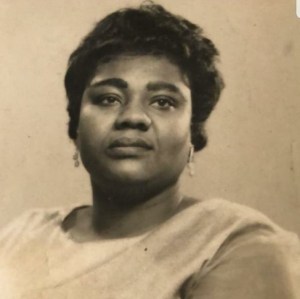
These passport photos show me snapshots
Of my mother how she looked back then
So royal and so innocent
An open-ended book without a pen,
But with determination in her eyes, I see the fog of pain
As she left the bright sun shining
She came here confronted by the rain.
There is something about black and white photos
That transport me back in time
As I see my mum all vulnerable
Her thoughts come out in rhyme.
Capturing her braveness, her honesty and loss
Neatly etched in each photo as she came across
the seas so blue, to make her world in a country not known
Dressed immaculately with each pose see took
Her strength within her eyes is shown.
But as teardrops fall so silently on cheeks so plump and round
Her plight was to take the son whose foundation laid in Jamaican ground.
But her family not yet complete till her son steps on British dirt
Only then could she sleep at night and fill her heart that hurt.
So painful it must have been her opened book played scene by scene
The mental scars within her head just showing where she had been
The visits that she made back home torn heart strings every time
She had to leave him home until her life was back in line.
Tony Goulding
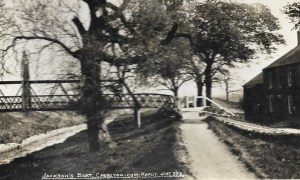
For me personally, and in general, this month’s topic has strong links to last month’s one of “family history”. My link is that my grandfather, who I never met as he died before I was born, was a professional photographer. Here is one of my grandfather’s photographs, made into a postcard.
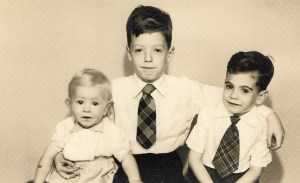
Generally, photographs mark the key moments of a family’s past and a way of recalling relatives who have died. In the early days of photography these family photos would mostly have been taken by professionals. Up until the beginning of the 1960s-decade photographer’s shops were still a common sight on the high street. Indeed, my parents used one to have this picture, showing me, aged 5, and my two brothers, taken professionally in September 1959.
With the development of cheaper and easier to use “instamatic” cameras the demand for professional photography in a domestic setting went into a steep decline and now tends only to be seen at weddings.
Now we are in the digital age in which nearly everyone is taking myriads of snaps on their mobile phones, as we are cajoled to “never miss a moment”. However, as with all advances in technology, all is not rosy. Unless important photos are physically printed off, they can be lost. Also, the creative nature of photography may be being devalued, so much alteration can now be made using computer software. It used to be said that you don’t “take” a photograph you “make” (1) one, now it is all too possible to fake one!
There are still, however, some photographs in which the skill and art of the photographer will shine through. To paraphrase the above adage “Everyone can “take” a photograph but only a few can “make” one.
Notes: –
1) Joe informed us at the session that in the German language the verb for the action of photography is indeed “to make”
Shane Murray
Me, Youand UMIST 1972
A small photo-booth portrait of her sixteen-year old self slips from the pages of an old diary. She picks it up and hands it to him.
“Oh wow, amazing!”
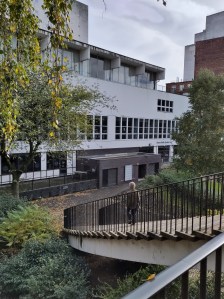
He is back in UMIST’s Barnes Wallis building, at the Saturday night disco in the autumn of 1972. It’s nearing the end of another sweaty, raucous night of drinking and dancing when he peers through his long, matted hair at a figure hovering in a corner of the darkened dance floor. Her ankle length skirt, tight sleeved top and dark, gently waved hair (parted off-centre), conjure up a benign Bonnie Parker. She commands his attention as their eyes meet, reflecting back his curiosity. Her happy face gives him strength to summon the scrap of courage he needs to walk over and ask her to dance. She gives him a beautiful smile, nods, leans in toward him and mouths something which is drowned out by the opening bars of Roadhouse Blues. They step and swirl and weave around each other for a few blissful minutes before the lights come up and the DJ announces the end of the night. They talk briefly, hesitantly, before her friend arrives and takes her away; she looks back over her shoulder, offers him an encouraging smile.
Later, he is shaken awake gently by the conductor of the all-night bus at Parrs Wood Depot.
“Missed yer stop son? Where you goin’?”
“Green End Road”
“OK. I’ll wake you on the way back.”
I never even asked her name, he thinks as he drifts off again, dreaming of Bonnie and longing for next Saturday night.
Barnes Wallis building, 2023. Awaiting demolition
—————-
The latest photo of the grandkids announces itself with a ping on WhatsApp.
“Who does she remind you of?”
He stares at the image and recalls a faded photograph of her as a child in the Nursery at the Cromer Cotton Mill – same chin, cheeks, brow, same blond cherub…
“Wow, she looks the spit of her grandmother!”
Annette Bennett
What is a photograph?
Literally a snap
Shot in time.
It can be one
On its own
Or a series
Telling a story
With a theme
Showing a scene.
Maybe a holiday
Recollection
A wedding celebration,
Birthday party,
Something interesting
That caught your eye
As you were passing by.


What is a photograph?
An image
Of happiness
Laughter
Enjoyment,
Sadness
Hardship
Endurance
Regrets.
Wonder
Amazement,
The truly stunning
Beauty of nature
And the world
Around us.
Everyday life
The ordinary
The extra ordinary
Affects
Just the same.


What is a photograph?
Through Our Eyes
It shows us
That we are all
Different
Individuals,
Special
Unique,
See our lives
What we
Or others have captured
In only the way
We can.
What captivates
Our attention
Interpretation,
Stirs our intervention
Or aesthetically pleases
Leaves us
At ease
Feel peace.

 The Stories of Our Lives