It was moving and thought-provoking to share our thoughts on the value of friendship. As you read on, you’ll see how some of us were inspired to express our feelings through poetry or prose. There are celebrations of, and tributes to, individual friends. Some tell of specific moments and some describe longstanding friendships. Then follow thoughtful reflections on the roles played by different types of friendships, the varied impacts they may have upon us or we have on them as we grow and change.
Joy Wassell Timms
You gave me red sandals, pleated at the front.
Then, after years, when I left the group
I sent you a letter
You never received the letter.

They asked you why I left - you my friend, could not answer.
You never received the letter.
Six months later I swallow pride and ring you.
You never received the letter.

So happy to hear me, I’m so happy to hear you.
Nothing has changed.
We laugh. Laugh together.
Anam Cara.

Pauline Omoboye
Lost and found


You came and brought my smile back
I had lost it weeks before
You had it held within your hands
Then brought it to my door.

Not wrapped, not bowed, just presented
You knew it belonged to me
You didn't even realise you had it
It came so naturally.

You brought me a smile well needed.
You gave me a flicker of hope.
Just when I had started wondering
If this time I would cope?


For years I have picked up many pieces
Stood tall without a crack
And now, after years of nurturing
You brought my happy Pauline back.

From afar, you felt the spiritual energy
You knew my sadness should come to an end
You came with my smile in your pocket.
You are a truly remarkable friend.


©P.Omoboye
Jean Byrne
My First Friend
The topic made me think about friendship throughout my life. One of the benefits of having a good friend is to temporarily give one the comforting feeling of not being alone in life. Sandra became my first friend when I was about 4 years old. Before that I always used to tag along with my older sister Maria and her friends. They didn’t like having a child 2 years younger around so they often refused to play with me or ran away.
Sandra lived in the flat next door. This was on the third floor of a block of council flats. There were covered spaces to play on the landing of each flat. Sandra used to play there with her golden Labrador Shane. He was a very placid dog so I was happy to chat to Sandra and play with Shane. There was a no pet’s policy in the flats but as the Council didn’t enforce this policy, everyone ignored this.
Sandra and I became best friends. She loved animals. Sandra and her older brother Paul always seemed to find injured birds and try to cure their broken wings or legs. They often had a box with something they were trying to cure on the doorstep. This was one of the reasons why I loved Sandra. Her mum was a nurse and I often wondered if this was the reason for their kindness to animals.
I cannot recall how this happened but Sandra and I both got black and white kittens. They were probably given to us by another neighbour who was desperate to get rid of them. Sandra’s was called Davie Crockett and mine was called Sam. We both got blue leads and collars with little silver bells for the kittens. We used to take the kittens out for walks around the flats and to the local play area. We enjoyed this but not sure now if the kittens did.

One year I got a post office set for Christmas. This had lots of blank telegrams, stamps and postal orders. When we couldn’t play out I used to send Sandra telegrams by posting them through her letter box. We didn’t have phones then. Sandra used to write letters back to me.
Sadly Sandra went to a Church of England school and I went to a Catholic one so we drifted apart.
Margaret Kendall
 L'amitié (friendship)

Abroad for the first time, only fourteen.
Bowls of café au lait, Gauloises-filled air,
the strangest of cheeses, evening-long meals
without a TV, no English allowed!
Homesick, of course, but now I look back,
my "maman du mois d'août",
my cousin's French teacher's friend,
showed such kindness and welcome
to our life "en famille".


Two sisters, two cousins, two sunny weeks
wobbling on bikes along Picardy lanes
picking blackberries from hedges, joining friends,
playing games. Listening to adults gossip
as we queued each day at each village shop,
fresh sticks of bread, meat chopped to order,
butter and milk, the paper for Papa.
Feeding chickens in cages and rabbits in hutches,
picking the veg and weeding the garden,
packing bags of flour in the family's mill,
getting tipsy on cider, vin rouge with water,
being stung by a wasp

I got better at French.


Back the next August, then two summers more,
the chance of a year to study in France,
and so, the friendship grew stronger. At twenty five
a surprise invitation: a birthday celebration!
I sold my bike for the money to go.
A glorious weekend at which began
a troubled romance with a friend of my friend,
more cross-channel trips till it ended sorely.
A mistake perhaps, but

I got better at French.

Our friendship survived: its foundations firm
though busy with families and demanding work
we kept in touch over so many years.
Postcards from travels, birthdays remembered,
cards at Christmas: little moments of pleasure.
Shared sadness by letter.
Then emails, then Facebook, then WhatsApp
refreshing our friendship and bringing us closer.
Now both retired, at the time in our lives
for new times of our lives, such joyful reunions!
I'm hopeful of more

I'm relearning French.
Shane Murray
A Unique Friendship
One day, when I was about fifteen, my sister brought home her latest boyfriend – a striking variation from the norm. He was a tall, thin, bespectacled, serious-looking man wearing a striped shirt, blue blazer and grey slacks – a younger version of Alan Whicker to my critical eye. I was not impressed. John was a nurse tutor at Withington Hospital where Teresa was a struggling student, putting all her energy into her social life. John gave her the encouragement and motivation to successfully complete her training.
I’m not sure when he stopped being her boyfriend and became a friend of the family. He would visit regularly and everyone grew to like him. My parents, coming from farming stock, made a connection with this farmer’s son from Shropshire. Our dad liked to talk to him about livestock, especially horses and cattle. My mother enjoyed his idiosyncratic sense of humour and his habit of talking in riddles. He rarely gave a straight answer, often leaving her exasperated before she collapsed in fits of laughter.
As the years passed, we four siblings went our separate ways but would often bump into John at our parents’ house. We loved catching up, sharing stories and enjoying his unusual take on life. He was that rare person who was always pleased to see you and somehow made you feel good about yourself. Attentive and curious but never prying, he was genuinely interested in our disparate lives. Occasionally we would visit him at his home in the countryside where he had a paddock with stables for two fine horses.
John was a very private man who eschewed parties, celebrations and any kind of fuss. But once he allowed our mother to interview him as an exercise for a writing class she was attending. She left us a portrait of a man of integrity and resolve, indefatigable in his personal and public life. So impressed with his work for the NHS and in the community, she secretly wrote to the PM’s office requesting he be honoured for his services. He never did get a gong but John would not have cared in the least.
The last time we saw John was in hospital. As I approached his bedside he smiled up at me, raised an outstretched arm in welcome and said:
“Brother.”
Remembering that simple greeting releases a flood of emotion, recalling a deep and lasting connection – a unique friendship.
Joyce Lindley
Friendship and a teapot
Well, it’s all very well decluttering as we get older, but so many of our useless objects hold fond memories and that is why we find it hard to part with them.
Take my little brown teapot….
The single-story hotel stood on the shores of N Wales across the road from the wide expanse of the sand and pebble beach. The wind over the grass-covered sandhills blew sand against the drystone walls of the hotel’s garden and one could often see rabbits scampering through them. It was a perfect getaway place, framed by the Snowdonia Range behind.
Friends of mine Joan and Mike, originally from Northern England, bought it in the 1980s and visitors were mostly parties from large institutions on their summer holidays, accompanied by carers. Many had learning or behavioural problems together with physical disabilities and the hotel was all on the level with wide doorways and large bathrooms to cater for wheelchairs. Often, I would travel up and stay with them. On different occasions I would take friends, relatives, my own handicapped brother and, of course, my elderly father. We loved staying there.
On one of these breaks, I witnessed an event that filled my heart with pleasure. Frank, a tall, white-haired pensioner from Oxfordshire drove himself to the hotel every year in a specially adapted car with only hand controls. With his wheelchair stowed in the roof and its descent electronically controlled, he was a wonder of independence, having lost the use of his legs in an accident. One morning Joan said “Make sure you’re here this evening won’t you” “Yes” I replied “is there something special on?” Norma’s face lit up in an impish grin as she explained that the daughter of an old friend of Frank’s, from RAF days, had learned that Frank was coming and booked in her father, Bill, as a surprise. They had kept in touch post-war but had not seen each other for years. “We haven’t got to tell him!” I promised secrecy.
That evening after dinner we sat in the lounge bar with Frank opposite the front door. We were trying to act naturally but were all waiting for the arrival of Bill. We heard a car draw up, the door opened and in walked an elderly man on walking sticks. Frank looked up to see who had entered and his face was a picture. At the same time, Bill’s face lit up and, recognising each other was a wonderful moment to see I can tell you. They were so thrilled. Joan gave Bill a drink from the bar and he sat next to Frank and began reminiscing about their time in the area when they were training at the airfield up the road. We couldn’t help but listen in although we tried. I don’t think they cared any way they were just enjoying catching up. The memories of these two friends came tumbling out one after the other. What an evening! One not easily forgotten by those involved….
To get back to the teapot. I had chatted to Frank earlier in his holiday and told him that I collected teapots. Many weeks later a well-packed parcel arrived through the post. Inside was this small brown unglazed teapot which I think may be a pumpkin, as it is decorated with leaves and has a stalk for the lid. Frank had sent it to me.
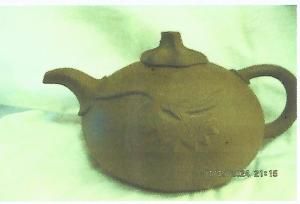
I still have it in my cabinet and whenever I look at it, I think of Frank and Bill as young RAF pilots doing their bit for their country and being lucky enough to survive, lead full lives post war, and, that happy reunion.
Mark Taylor
There’s a saying: new friends are silver and old friends are gold. This seems to me a rather unambitious classification system when we have a whole periodic table to work with.
Some friends are copper: connecting, conducting. Some are potassium: fizzing, reactive. Some are helium: they do a funny voice, they lift you up, and despite seeming frivolous they turn out to have a surprisingly important job in medical imaging. Some are carbon, and can take a thousand different forms, all of them useful. Some are plutonium, and if you get too many of those together, you’re in big trouble.
This combination might taste sweet and that combination might glow. This is what we mean when we say people have chemistry: that they combine to make something new and different. If you have ever felt unfit for friendship, remember that sodium explodes and chlorine is toxic but sodium chloride is table salt. Friendship reveals properties within us that are invisible when we are alone.
Chemistry is essential to life, but alchemy is folly. I have been guilty at times of the alchemist’s mistake, wishing to transmute my friendships into something more valuable, and losing sight of how precious they already are.
In truth I don’t think friends are gold or silver or lead or platinum or titanium or mendelevium or tin. I don’t think friendships can be weighed against each other or compared in value or laid out in a table. I am very wary of any voice that tells me what “true friendship” is or isn’t, even (especially) if it comes from inside me. There are billions of true friendships in the world. Each one is unique, intricate, multiple and ever-changing, and they are all oxygen.
Jean Thompson
Friendship
As the saying goes, you can choose your friends but not your family. While you hope that family will be friends too, the basis of friendship is different from the basis of family relationships.
Friends can come along from many different situations. I have friends from Primary and Secondary School that I am in regular contact with, even though we have all moved around a lot, in the 60 or 70+ years we have known each other. Over that time we have lived different lives, changed quite a lot in our views and personalities but when we get together the years just fade away and it is as if we are as we were as youngsters.
Because we have known each other so long and have shared family and life’s experiences, does that make us more tolerant of foibles and beliefs that we might not accept in someone we met last year? That’s an interesting point. Friends that I have made much later in life tend to have the same interests and viewpoints that I have; tend but do not always have. So what makes you regard a friend as such and other people that you know just as acquaintances?
There is a point of view that people are either radiators or drains. So they either give out warmth and positive energy (radiators) or sap the energy of others and take everything from them (drains). In true friendship you should be both things at different times. So give out warmth and support when needed, but also be able to take away some energy when you need it yourself. I am sure we all have so called friends which start a conversation with “how are you” but then proceed to tell you how they are, what problems they have, and the initial question they asked you fades away. Not that mutual sharing that true friendship should have. Not a sharing of radiator or drain!
The books about Winnie the Pooh are delightful but also insightful. I love the chapter where Pooh and Piglet haven’t see Eeyore for a few days so go to visit him. In typical Eeyore fashion he is very morose and does not want to talk, so they just sit quietly with him in silence until slowly Eeyore starts to feel slightly better. No words or extravagant gestures needed, but an understanding of friendship.
Jolene Sheehan
Friendship is a Laboratory Where We Experiment with How the World Could Be
I have come to see friendship as an ongoing collaborative inquiry, where we explore self-discovery, push boundaries, explore wants, acknowledge needs, and share our unique gifts within a supportive environment. In this way, the laboratory of friendship becomes the space where we experiment with and refine our learning about ourselves and life. We span various disciplines as we do so, ultimately extending our newfound wisdom to the broader world.
In the sociological field, we can explore and question societal norms. Establishing where patterns come from, we ask questions like ‘Who says friends have to fit a particular mould?’ Through our investigations, we get to challenge the “shoulds” of the past and embrace the uniqueness of our connections and how they change with different field dynamics.
Psychology comes into play as we explore individual needs and reactions within friendships. What part do our childhood influences play in how we interact? How can we bring more choice and responsibility and less reaction to the mix?
Physics reminds us of the dimensions of time and space in friendships. How does time affect the intensity of our connections? When, how, and where is it best to foster connection? These are the variables it is helpful to track!
In the chemistry lab, we’re observing reactions. Seeing how some friendships sizzle dramatically and then fizzle out quickly, while others effervesce gently, nurturing our souls over time. We’re avoiding toxic combinations and seeking those that nourish us. We diligently mix different elements to see what sparks joy and connection, and occasionally, our labours are rewarded when we stumble upon a magical formula. (Eureka!)
Biology joins the investigation as we acknowledge human factors—tiredness, change of phase, emotions, and the ebb and flow of life. These elements enrich our work, making the results even more intriguing.
The way I observe it, friendship experiments happen all the time, whether we consciously guide them or otherwise. But to conduct investigations with the best chances of clear learning, setting some ground rules is helpful. This means it’s best if all researchers agree to the same hypothesis, methods, and materials. Friends then get to grow in understanding together as lab partners, co-creating and learning, not ending up as lab rats for each other’s scrutiny and judgment.
Like science, friendship is an active process, constantly evolving. In this way, we cannot fail, we can only learn what doesn’t fit a hypothesis, leading us to reflect and grow from our experiences.
Admittedly, sometimes experiments do end abruptly, leaving us with plenty of data but no one to reflect with. Yet, with a bit of thought, each experience can still add to our knowledge, helping us see how the world could be through the alchemy of friendship. It’s a continuous journey, where we grow in understanding, extending the lessons learned to enrich our interactions with the world.
Tony Goulding
The meaning of friendship
The word “friend” has regrettably been seriously devalued in recent years by its use as the term for connections made on Facebook.
It is common for people to have literally thousands of friends on the platform, only a few of those befriended in this way would ever meet face to face. More importantly, these friends would only know them through the things they share on the site which by necessity must be a somewhat sanitized version of themself.
Friendship in its truest form involves an individual letting their guard down so that another can get to know a real person, “warts and all”. I am minded of an old adage: –
“A true friend is one who knows all about you and loves you anyway”
As a response to the dilution of the meaning of friendship through its overuse on social media I would end on this thought, paraphrasing an annual advert of the R.S.P.C.A.
“Friends are for Life, not just for FACEBOOK”!
Annette Bennett
Friends.


Friends

Are the

Sunshine of life

It is true

Without them

What would we do?.


Friends

Come in all guises

Shapes and sizes,

Human

Animals

Maybe through

Technology,

Across the miles

To bring us smiles.


Friends

Laugh with us

Cry with us

Are there

By our side

To guide

Through thick

And thin,

Sharing life’s

Ups and downs

Whatever the ride.


Friends

Let’s celebrate them

And be always

Thankful they

Are ours

Along the journey.

Worth their

Weight in gold,

Treasures to

Dearly hold,

Making everyday

That bit brighter,

Lighter,

Lifting clouds

Far away

To stay.

 The Stories of Our Lives