In partnership with Arnold & Komarov Wandertheater, and their latest project, we’ve been exploring the fascinating relationship between love and work. As Trixa and Ilya from the theatre company explain, “We’re examining the positive and negative interactions between love and working life, aiming to understand how people would shape their lives if they had complete freedom.”
Inspired by this theme, we held two workshops to reflect on our own experiences. In the first session, Trixa and Ilya introduced us to global perspectives through a video and a collection of writings, sparking deep personal reflections. We then discussed and wrote about our own thoughts on the interplay of love and work.
In the second session, we anonymously shared our writings, leading to a rich discussion on topics like the evolution of love and work, identity in the workplace, and the role of relationships in professional life. The diverse ideas that emerged were inspiring. We thank Trixa and Ilya for guiding us through this exploration and hope you find our reflections as engaging as we did.
Jolene Sheehan
I often need to express my thoughts—whether by speaking, writing, or taking action—before I can fully understand them. This process, driven by curiosity and collaboration, helps me learn and grow through feedback. In my work, I’ve embraced this approach, viewing teaching as a form of learning. Rather than presenting myself as an expert, I explore alongside others, staying open and transparent. This can be challenging in a culture that values polished professionalism, but I remind myself that being authentic is more important than striving for perfection.
For 22 years as a secondary teacher, I wore a mask of authority, which never felt natural. While I enjoyed working with young people, the role was exhausting and disconnected from my true self. Since becoming self-employed five years ago, I’ve been able to embrace my creative and exploratory nature. I’ve learned podcasting, published books, co-created blogs, and run workshops. Though I sometimes worry about being scattered, I’ve realised that my ability to grasp the big picture, identify knowledge gaps, and balance light and deep processing helps me find a rhythm that works for me.
Embracing my imperfections and the journey of learning as I teach has become an act of self-compassion. It’s not about being perfect but about authentically expressing who I am. For me, this is the essence of love in work—a continuous evolution that challenges and nurtures.
Jane Graham
Love, Work, so necessary for life, and yet, unlike breathing, not always there. Both have many connotations; the whole spectrum of emotions which make us human. The only way to gain insight into these words is at, home! Years of living at home has given a pattern which has every variation – and its absence. So many stories of life at home. All varied according to who is telling it. But the basis is always how love and work make the home and its members feel secure, permanence, roots, continuity.
Skills. Both love and work require constant attention, years of attention accompanied by tears and laughter. The recognition that despite the absurdities of this world we can only keep on loving and working.
Patrick Steel
Long retired, I wish I knew then what I know now about choosing a career. I would certainly advise a younger self or any young person to do differently.
A schoolteacher many years ago asked me on more than one occasion, “What do you want to be when you leave school…a deckhand on a submarine!” He certainly knew how to get laughs from my classmates. Maybe he was trying to be helpful but in response, I spent my life trying to find utilitarian jobs that were oftentimes very uninteresting. Where I could be of most service, a sense of duty etc. This contrasts sharply with the wisdom expounded in the workshop today: the importance of being passionate about your work, listening to your own feelings etc.
Fairly late on in my career, I tried to make my work more about relationships. I remember attending a professional development course (at my own expense too) where I posited that as we work for ‘companies’, we should prioritise companionship as a goal and see where that leads us. Nobody commented. Maybe they thought I was from another planet, and good luck with that notion!
Anyhow, I’ve just enjoyed watching the 2024 Olympics. Not in the labour market, just as a TV spectator. I especially enjoyed the swimming races. Someone observed that we should feel really sorry for the lifeguard as it’s a useless task. A chocolate fireguard/teapot etc. But do you know what, I bet he had a ringside seat… and ‘the best time!’ Who’s the real winner there?
A conversation with Nouri Marvi by Jean Thompson
I worked from the age of 14 or 15. Sometimes work was a challenge but I enjoyed that, and it gave me comfort and a sense of satisfaction in my life. I did many different jobs, from the early days I learned from watching older workers and I followed what they did and made progress in my working life learning many new skills. For a time I was a teacher and enjoyed that time but I had a family by then and my wife said it meant that because of the long hours I was spending at work, I was missing out on family life and seeing my children growing up. I loved my wife and children so although I also loved teaching I decided the cost was too much so looked for something else.
When I came to England I was much older and although I found work the skills I needed were different from the skills I had previously learned, and it was hard, but I persevered and earned respect from my employers until it was time to retire. For me comfort has come from loving work and family both and overcoming the challenges involved.
Shane Murray
Hands
In rural Ireland the laws of primogeniture and economics dictated that my parents would eventually leave the people and the land they loved in search of work. They came to England and fashioned a lasting union of romantic nationalist and steady pragmatist.
My mother was pulling pints in a pub in Moston when a darkly handsome stranger walked in and captivated her. My father had boarded the train of Irish history and joined the legions of navvies who built England’s canals, railways, motorways and houses. His tales of toiling in the earth made this boy, head in a book or in the clouds, appreciate the privilege of not having to work with his hands. On the rare occasion when I stop to gaze at my parents’ wedding photograph, I am always drawn to my father’s enormous hands.
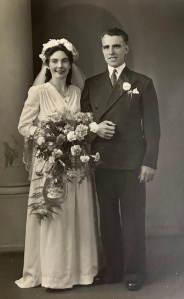
As a child he would ask me to remove splinters from his hands when he came home from work. Spreading the fingers of his great brown calloused paw on the kitchen table, he would hand me a sewing needle and instruct me to break the skin encasing a black sliver of wood and tease out the intruder. I was apprehensive, fearing I would hurt him. But contemplating that great shovel of a hand and his calm demeanour gave me courage. Besides, this was the hand that dispensed a silver sixpence when I asked for a thre’penny bit to spend at Nelly Hennessy’s.
Once we had a charity fund-raising competition at school with a prize for the class that collected the most labels from Heinz soup cans. Dad brought home great wads of them each day from his ‘canteen.’ He must have gone to some trouble to retrieve those cans and carefully peel away the red labels. Our class won by a mile and the teachers decided to award me a special prize, a huge jar of sweets. I felt something of a fraud having done nothing but reap the rewards of my father’s efforts.
When his body could no longer bear the rigours of labouring, Dad got a job at my primary school (he waited until I had left) as caretaker and gardener for the church and school grounds. Many years later, I learned there was a boy at the school whose mother had died and my dad took him under his wing. They tended the gardens together. I like to think it brought some comfort to the child. Dad loved his work and shared that love in his own gentle way.
Jean Byrne
My last two jobs, the ones I loved the most
In 2011 due to the Coalition Governments austerity measures I was told my job would cease to exist. I worked in the Book start Team which was part of the Sure start initiative. Our main tasks were to inspire a love of reading and improve standards of literacy for under 5s in Manchester. This involved working with Registrars, Heath Visitors, Sure start Centres, nurseries and schools to distribute 20000 Book start packs each year to all under 5s. My job involved helping at events involving families with young children. This included regular story and rhyme time sessions in libraries for toddlers and pre-school children and providing parents with help and support to teach their children to enjoy reading. Tasks included singing nursery rhymes, helping children with craft activities and occasionally dressing up in a very large Book start bear outfit to present young children with certificates when they had achieved exceptional targets in borrowing library books. To tell the truth every day was fun and it didn’t feel like work. I was given the option of accepting redundancy or being transferred to a vacant post working as a library assistant.
Losing a job that I enjoyed so much could have been a tragedy but it turned out to be a blessing. It felt like I had been made redundant and won the lottery on the same day. As a lifelong library user and avid reader the new job suited me so well that it almost felt wrong to be getting paid for doing it. Being surrounded by books all day was my idea of being in heaven. One task I enjoyed was shelving books people had returned. Through this I learned the intricacies of the Dewey decimal system and other methods used to organise the books. Another enjoyable task was finding books that members at other branches wanted to borrow. It felt like being on a treasure hunt every day. Through this I discovered books and expanded my knowledge on topics that I would not otherwise have seen. I always kept my own library card with me in a little cloth shoulder bag. If I came across anything interesting I would put it to one side and borrow it while taking a break.
To me libraries offer a small beacon of hope in this harsh and hostile age of austerity.
Margaret Kendall
“Smile though your heart is breaking” Advice my manager gave me at an induction session in one of my first workplaces. It’s good advice for a public-facing role: people need to feel welcomed and cared-for. Looking back over my working life, in both the rewarding or more mundane positions I’ve held, I remember how it also helped me to put to one side whatever else was going on and to wear that public face. I remember too the kindness “behind the scenes” of those colleagues and managers who showed an interest and asked how things were going outside of work, especially during the tougher times. I hope I gave the same support to others. I can think of occasions when I could have said or done more, but then no-one’s perfect are they?
Until we talked about it in our meeting, I hadn’t thought to use the word “love” in relation to the workplace, but I see now that caring about other people and making working relationships successful is a kind of loving. Experience from other relationships is transferable too, and vice versa. For example, labours of love such as caring for children, other relatives and friends. Any kind of loving can be a challenge, but worthwhile. We need one another.
Pauline Omoboye
Work

Work is a task
It's time going fast
It’s a lot on your mind
It can also be hard to find.
Work is looking after the kids
Work is cleaning the fridge
Work is rehearsing that dance
Work can be taking a chance.
Work is preparing for a date
Work can make you late
Work is a means to an end
Work is keeping a friend.
Work is being in labour
Work is sometimes asking a favour.
Work is as hard as you make it.
Easy when you fake it
Work.

P.Omoboye ©

Love is...

Love is...
Sharing, even if you don't want to
Caring, when you really can't be bothered
Staying up late so your partner has someone to be scared with while watching the latest horror film
Love is…
when you’re trying to sleep with your partner's bedside lamp on
Love is...
Having to wait
or saying it's O.K. when she turns up late
Love is blind....
You can’t see the wood for the trees
Love is …
when you back down to please
Love is...
laying down the law, when you have had that argument before
Love is...

Sharing your last Rolo,
the washing up and your side of the bed
Love is bliss...

Or is it?

P.Omoboye ©
Tony Goulding
The connection between “Love” and “Work” is both intricate and intimate. Work is largely undertaken to provide for the material well-being of loved ones and in many instances results in sacrifices in the emotional lives of both the worker and their family. To combat this, it is necessary to remember that work is a means to an end and not “the be all and end all”.
Much of our self-love is engendered by how we regard our employment status. A ‘catch 22’ situation can arise in which a menial job leads to low self-esteem resulting in poor job performance and a downward spiral ensues. Happily, however the reverse is possible in which doing a job, whatever it is, to the best of your ability can lead to greater respect in the workplace and a more positive self-image. Overcoming problems arising from the working environment may lead to personal growth but do have a related danger of distorting the work / life balance. It should also be noted that a person is much more than an “economic unit”; work done for non-monetary gain whether it be in the home or in a voluntary role is often of great value and is largely done for love.
Finally, hobbies are work done purely for love and it can be surprising (“though one should never judge a book by its cover”) how freed from the pressure of full-time work how much these can flourish in some retired people.
Sue Ash
Thinking about this project before the meeting, I couldn’t find an obvious connection between these two words. ‘Love’ I automatically link with close relationships with people, be it children, relatives, partners, friends. ‘Work’ I think of as being a task that takes mental and/or physical effort to achieve a particular goal that will contribute to maintaining our way of life.
We listened to several pieces written about this topic, some by members of our group, some written by others. My overall impression was that, for the majority of pieces, the authors too had found it difficult to link the words. They seemed to focus on one word only.
Discussing this topic in my breakout group led to numerous strands, including how the meaning of these words had evolved over the centuries, and even thinking back to our cave dwelling ancestry. We focused on the use of the word ‘work’ and the variety of how and what some people perceive as work.
Based on our own lives, our view was that some things identified in modern society as ‘work’ are necessary tasks that have always existed to ensure the health and safety of the family unit.
We talked about tasks we undertook when we were the in the middle of three generations consisting of our ageing parents, ourselves as adults, and our children. We didn’t perceive this as ‘work’, rather as an inevitable duty as we progressed through our adult years. For those of us in the group, we were pleased to meet these duties to return the care we had received in our own childhoods, and to provide our children with the same level of care we had received. We did this out of ‘love’.
A thought was that the term ‘work’ for tasks within the family could possibly have come about because of the changes in standards of living. The number of utensils and physical effort needed to maintain these standards, many on a daily basis, can be tedious and tiring. For example, there was a time when most ‘working class’ homes would have had bare stone floors on the ground floor, and cleaning utensils consisted of a broom and possibly a mop and bucket. These days adverts tell us that we need to use expensive appliances and chemicals to ensure our carpets and furniture are dust and germ free.
Jean Thompson
Two great and very thought provoking sessions on Love**Work. One session by video with the Arnold and Komarov Theatre group, and one in person.
Are Love and Work two different entities, or intertwined? Do we work to underpin all the other things we love in life? How close are love and work?
Love Work
Wove Wore
Wore Lore
Work Love
Just one letter away on each ladder.
We are lucky if we work at something we enjoy, even love. We are lucky if our work gives us time and energy to enjoy all the other things in life. Accepting that a job well done to the best of our ability is one way to achieve satisfaction, even if that job is not what we would ideally want.
When we talk about work, are we just thinking of paid employment? There are many types of work that are not paid but are so valuable. Caring for family and community. Voluntary work. Do we love the work more that we are not compelled to do, but do through choice?
Do we have to love ourselves first and then love for everything and everyone will follow?
This topic provoked more questions that there were answers. Perhaps that is because there are no definitive answers. Love and life are the proverbial works in progress always.
Joyce Lindley
Find a job you love
It may take time to do
Have patience
but you'll find my friend
Your life will start anew!

At home, in garden, on the net,
gigantic or just small
Have pride and say
“I did it well”
and give that job your all.

That's the secret
I have found
Just work with love
and love your work
and spread that love around.

 The Stories of Our Lives