Tony introduced our session on this topic by showing us his large collection of concert and football match tickets, programmes and memorabilia going back many years. They included some Manchester City match tickets his uncle had given him from the 1950s. We were amazed at the difference in the entrance prices between then and now!
He got us thinking and talking about our own experiences of attending concerts and sporting events and sharing our memories of what they had meant to us. Some of us recalled specific occasions we’ll never forget and the people we were with, others reflected on the significance in our lives of music and sport, whether or not we were fans ourselves.
Tony Goulding
After half a century of attending a multitude of sporting events, and a smaller number of concerts, I have found it impossible to choose one. Therefore, I have decided to reflect on the difference between passively watching or listening to an event at home and being physically present in the arena. The most obvious differences are the need to organise tickets for the event and a means of travel to the place where it takes place, thus involving a much broader experience. The travelling will also often mean meeting friends and family with the occasion becoming a communal activity. It also often involves visiting other towns, cities, and sometimes countries and this provides an opportunity for sightseeing or an extended break as I have done around cricket in Worcester and football in Lincoln and several European adventures!
Inside the venue itself, attendees get a much richer flavour of the contest or performance. There is much interaction both among the spectators / audience and between them and the performers they have come to see.
These ancillary details often become the abiding memory. In this way I recall the banter from the crowd at one of the first cricket matches I attended as Brian Statham in his final game for Lancashire produced a superb spell of bowling taking 6 Yorkshire wickets as they were skittled out for just 61 in the “Roses” match at Old Trafford. Then there was the way I came by an elusive ticket for a League Cup Semi-Final Manchester City vs Manchester United at Old Trafford in 1971 which I discovered on the kitchen table on returning from school; my father having somehow been able to obtain one.

Finally, and much more recently, was my experience of travelling alone to Istanbul for the Champions League final only to find on taking my seat that completely by chance I was sat next to the friends I normally travel with to City’s matches at the Etihad.
In preparing this presentation I found that whilst I had little memory of many of the events themselves the connected details readily came to mind. Some of the events I have witnessed are now regarded as iconic moments and it is a matter of some pride that I can say in the phrase made famous by Max Boyce “I know ‘cause I was there”. Incidentally if everyone who claimed to be at these events were actually there, the attendances would have been much larger!
The draw of these major events can be seen in the recent frenzied clamouring for tickets for the Oasis reunion shows. The need to mark the occasion is evident in the trend of purchasing a “match scarf” on which both teams are recorded and the mushrooming of merchandising at these events generally.
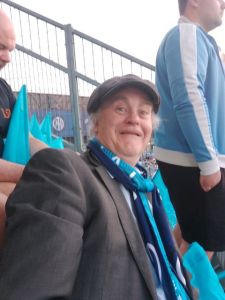
Jean Thompson
Such a great presentation from Tony who clearly expressed and demonstrated his dedication to the beautiful game (football to the uninitiated) and concerts he had been to with his amazing collection of programmes and tickets.
With apologies to Tony (!) as a loyal MCFC supporter, although I would not describe myself as a football fan, my whole family are Manchester United fans, my late husband even being a season ticket holder. When he died someone must have told the club because we received a lovely personalised letter of condolence form Sir Alex Ferguson. Treasured by all of us.
We lived within walking distance of both Old Trafford Football Ground and Lancashire Cricket Ground and when there were concerts on at either place, if the wind was in the right direction we could hear them from our garden. That’s one link! My husband always said he would not want to move house because come rain or sunshine, he loved the walk from home to the football ground meeting up with other dedicated fans on the way there.
My sister-in-law is an avid sports fan in general, and if ever I am on holiday with her, whatever city and country we are in, we have to go to pay homage to the football ground or sports stadium. She is also an avid concert goer, but I decline going to those with her as in her mid-sixties, she still loves nothing more than getting down and dirty in the rock Moshe pits.
What always amazes me is that wherever you are in the world, even when I worked as a volunteer in some deprived areas of Bangalore, mention you are from Manchester, and forget the rich history and culture, everyone knows about the two football clubs, and without fail, everyone also knows far more about those teams than I do!
As for memorable concerts. On one level, Rod Stewart has to feature large. My family know that one of the choices of music at my funeral should be an appropriate song by Rod. In a different context, The Proms at The Albert Hall was an experience not to be forgotten, as are always the concerts and operas at the Royal Northern College of Music, by the students who always give it their all, and whose expertise and enthusiasm is a joy.
Enthusiasm and joy, two good words for the love of both football and concerts and life in general.
Joyce Lindley
Many years ago in Sydney, Australia, I loved the open-air events which were so popular in that climate. The one that sticks in my mind was a performance of the opera “Die Fledermaus” or “The Bat” on the lawns of the Botanic Gardens by the harbour. Sitting on low picnic chairs and blankets, with containers of food and bottles of drink we had brought, the sea lapping at the harbour wall, the opera house and bridge against the sky—it was magical! In front of us, the orchestra assembled, quietness fell and just the libretto of the story sung by well-known singers started.
The opera is a highly comical German tale set in regency times and involving a prank played on a young man who drinks too much and then, dressed as a bat, is deserted by his friends, ending up in jail. Afterwards, it involves his attempts to get his revenge on them. It also involves a romantic intrigue.
As darkness swiftly fell over the gardens somebody looked up and said “Oh look!”. We looked up and above us were black shapes flying over. “It’s the bats” came the cry and, sure enough, a flight of fruit bats were passing. “They’ve come to see the opera” was another cry, and a wave of merriment spread through the crowd before we could contain it and concentrate on the singing again. It seemed the bats, which roosted through the day, were coming out to feed.
Suddenly a downpour of rain occurred. The music stopped, the orchestra retreated, and many members of the audience left. We covered our heads with umbrellas or macs, and just waited, and waited! After about 15 minutes, the rain stopped, the orchestra reassembled, and finally the conductor appeared to a great roar of approval from the crowd. He lifted his arms for silence and, with a broad smile on his face said, “thank you everybody!”, a pause, and then “Now we know who the real opera lovers are!” and with that turned around, raised his baton, and the opera continued with the lovely music drifting all around the gardens in the soft evening air. A memorable night indeed.
Margaret Kendall

In 2015, I was apprehensive about going to WOMAD (World of Music, Arts and Dance) with friends. I’m just under five feet tall and my chief memories of going to see bands when I was younger, mainly as a student, were of frustration at not being able to see much in a crowd of taller people. In those days, even in a concert hall with numbered seats, people stood up to dance or rushed to the front to be closer to the band, blocking the view of those behind. No doubt I still had fun at the time, but I wasn’t sure about repeating the experience.
However, what a great time we had over those four days! It was relaxing to hear such a variety of music outdoors and to appreciate the wonderful, joyful atmosphere. The festival took place (and still does) in the grounds of Charlton Park, near Malmesbury in Gloucestershire. The stages were high enough that I could still see and the sound systems meant you could hear when standing some distance away.
The highlights for me were hearing a powerful set by Laura Mvulu, the folk band Bellowhead, a group of Master drummers from Ghana and a lively tango orchestra from Argentina playing accordions and violins. I was also pleased to find that there were quieter spaces in the arboretum away from the crowds, a poetry and spoken word area called “World of Words”, and music workshop areas. The variety of food from round the world was great too. Even when it rained and we went inside a crowded marquee to see a popular band, I found I could watch the screens of people holding up their mobile phones and iPads to record the music, and get a closer view that way. Who’d have imagined that in the 1970s!
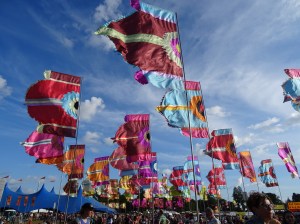
I don’t think I’ll ever want to go to a larger festival, like Glastonbury, but it was a lovely experience, which my partner and I were happy to repeat the following year. We had the benefit of our campervan on both occasions, somewhere warmer and cosier than being in a tent, especially when it rained for three of the four days that second time. We joked then about having been to WOMUD instead of WOMAD!
Jean Byrne
The Burbage Brass Band: a memorable evening at Stoller Hall
This event was a combination of history and music. Two topics of interest to me. It is an Arts Council funded project to record the history of a village band which has existed since 1861. The band was set up by a quarry owner with support from the Church and the Duke of Devonshire “to teach music without charge, provide a healthy and constructive pastime, develop community spirit and entertain.” Another aim might possibly have been to provide the workers with an alternative pastime than going to the pub. The band has kept going mainly due to the founding principle that instruments and teaching are provided free for anyone who wants to join. A large training band of young people are attached to the main band. Three generations of some families are involved and over 80 % of the main band members have come from the training band. The current conductor has led the band for over 30 years and been a member for 40 years. Another reason the band has continued is probably due to the dedication and perseverance of people like him whose commitment is essential to keep groups going. Are people who dedicate their time to clubs and societies in this way a special breed or can we all aspire to this?
We learned from the narrator and a slide show that in 1915 the whole band volunteered to enlist in World War 1 together, 16 members were accepted and they took their instruments with them and marched off to war together. 14 returned after the war ended.
At Stoller Hall, the band played songs from throughout their history. They also brought along and demonstrated some of the original instruments including an early type of euphonium called an ophicleide. They explained a bit about the competitive nature of Brass Banding in England. It seems to be organised on similar lines to the football league with annual regional and national competitions
The event was very moving. Many of the audience were family members of the band. As an outside observer it was interesting to see how the band members, who have played together for many years, communicated wordlessly together via the music. It demonstrated to me the basic need many of us have to be part of something bigger than ourselves with other human beings.
Patrick Steel
Sporting Events/Concerts
The word ‘culture’ springs to mind when I think of my attendance at these events. Not because I liken it to opera or the ballet, but because for me it’s the overriding sense of belonging or connection with others.
I remember attending a Bob Dylan concert in my youth at Blackbushe, down in the south of England. I don’t remember much about Bob or the concert, but the road trip there with a few friends, stopping off to try Old Peculiar ale in the Midlands and the togetherness are what I remember.
That said, the culture of these public events does seem to evolve over time. Tennis in my youth was a quiet, reserved, affair. Recently, I attended the Davis Cup in AO Manchester Arena. I got in just in time for GB v Argentina. There was a lot of noise from the audience, and the small band playing after every rally were so loud and disruptive, I initially thought that they were the opposition supporters…until I saw the flags etc. Both male tennis players were grunting loudly after each shot too, which I thought was a bit unsporting. But it was when the house DJ played, “We will, we will rock you!” in the intervals that I realised that times had truly changed.
Shane Murray
18 June 2008
The telephone rang.
“Hello, this is the Opera House, Manchester. Mr. Leonard Cohen respectfully requests we remind you that tomorrow night’s performance will begin promptly at 7.00 pm. Please arrive on time and take your seats before the start of the show.”
Josie relayed the message to me and our friends from Gateshead. We all started talking at once, wildly excited at the prospect of seeing Leonard again after so many years. Our son, amused at witnessing the fervour of middle aged fans behaving like adolescents, said wryly:
“I hope you won’t be disappointed.” We laughed at the notion.
It was forty years since Leonard Cohen had released his first album. He was an outsider then, having left Hydra and his muse Marianne, to join the sixties music scene at the superannuable age of 34. He stared from the sleeve of his first album, a sombre academic in formal shirt and jacket, hair brushed conventionally. But the intensity of his gaze was hard to ignore. It seemed to say:
This is serious. These songs could change your life.
In four decades Cohen had lived many lives – novelist, poet, lover, singer-songwriter, Buddhist monk and latterly – impoverished legend.
At last, the evening arrived. We were seated well before the start of the concert, stomachs fluttering with nervous anticipation, like children at Christmas. The musicians and backing singers took their places. And then…Leonard, impeccably dressed in suit and fedora, holding his black guitar, strode out onto the stage, his bashful smile greeted by thunderous applause and a sea of joyous faces.
Looking back now, I don’t remember the detail. He played for three hours, almost levitating on the love in that arena. He was our great troubadour – charming, witty, self deprecating; the deep bass voice perfectly suited to his wonderful catalogue of love, loss and longing, the soundtrack to our lives. When he sang:
I’m crazy for love but I’m not coming on*
a woman’s voice called back clearly
Oh yes you are Leonard!
We cheered. Yeah, still got it at 74!
As disciples of Cohen we didn’t judge too harshly the manager who stole his pension fund. Rather, we offered prayers of thanks. It forced him out of retirement and back on the road where he found his audience again, waiting to give back the love he had shared all those years.
*Cohen, L (1988) Tower of Song, Stranger Music Inc.

Mark Taylor
Give me
A good friend at a bad gig
A good laugh at a bad play
A good pie at a bad match
Give me
A card game on a stopped train
The pub next door to the sold-out venue
Dancing in the street outside the stadium
Give me
The understudy
The support act
The second half
Whatever else I say, I’ll say: “Remember when…?”

 The Stories of Our Lives