We had a thoughtful and meaningful discussion following on from hearing Jane’s story about her involvement in supporting a group of gypsies who were being harassed. Our responses included reflections on similarities from our own experiences of feeling like an outsider, on prejudice and how it comes into all our lives, and the complexities of finding solutions.
Jane Graham
In the 1970s, I belonged to a group who took non-violent action against social injustice in many things. I was not the main initiator of most of the causes we acted on. In this particular case, it was the gypsies who were being harassed. Urban development since the war, such as large housing estates like Hattersley and Wythenshawe, had been built and encroached on sites traditionally used by gypsies. The new residential communities did not want gypsies living nearby and complained about them.
Before we came to Manchester, I often remember seeing gypsies on lay-bys on the roads in Kent. We knew the police would not allow them to stop there. The Government realised the problem and in 1968 required local authorities to provide sites in their area. It must be remembered that the nomadic gypsy way of life was a recognised lifestyle in this country, lived by people who had a long history of being here.
The local authority had a hard time, any site proposed was opposed by nearby residents who complained about the gypsy lifestyle, saying things such as: “They have dogs, open fires, rubbish everywhere. They are dirty, thieves, swearing, we’re frightened to let our children out”. There were often ugly scenes, and the police would be called. This resulted in a lot of short-term sites which was hopeless for the gypsies who could no longer do the work they had traditionally done. Usually, they had assisted farmers throughout the summer with planting and bringing in the harvest. They did car-breaking on their site or sold handmade wooden pegs door to door with a piece of “lucky” heather or even told your fortune.
Some members of our group in Manchester, which was made up of lawyers, architects, teachers, social workers, students and members of the community, went and had discussions with the gypsies to offer them support against this harassment. It was agreed that when we heard of gypsies being removed from an area and with no legitimate site to go to, we would go along and sit round the caravans to prevent them being moved until a site was available. In those days, it was telephone trees and shared cars that got us to where an eviction was taking place, which was usually at dawn.
The scenes at the gypsy camps were always sad. Not only seeing children’s faces peering out of caravan windows, but the early morning dawn was often wet and cold and the ground very muddy. The sites were strewn with things, indicating they had had to gather possessions together quickly. Some caravans were not in good condition and the rough way the local authority workers went about towing them away was tragic to see. The women and children were usually either in the vans or kept away from where the police and workmen were, the gypsy men arguing.
In the early 1970s, we were kept busy because if they were moved to a new place, very soon the local authority had complaints. It seemed like deadlock, with no hope of resolving the situation. Some gypsies moved away to rural areas. Our group, besides protecting the gypsies from being removed, also supported them against accusations that could be proved not to be true, and we also ensured that neither the police nor local authority workmen behaved outside the law. Some of us were NCCL (National Council for Civil Liberties) observers who would report any illegal behaviour by the authorities, e.g. no vehicle could be moved if someone was inside it.
Sometimes it was a cold, wet, hostile environment we went into, on other occasions it was quite friendly. There was one occasion I remember, when one of our group, an Irish man working as a teacher in Manchester, was talking to the workmen who were also Irish, and the policeman, also Irish, joined in as did one of the gypsy men. There was a lot of laughter on that occasion and no caravans were removed!
This situation for the gypsies continued for about two years until the Croft on Oxford Road was lying empty and was not due to be built on for some months. We encouraged gypsies to move onto it because it was opposite the Students’ Union and the Community Action group there were willing to support the gypsies by letting them use their facilities. About the same time, Manchester City Council had found a place on railway sidings behind Victoria Station where there was no local community, and they were preparing a gypsy site. It would be some time before it would be ready.
Now our group was able to get closer to the gypsies, the teachers started a school, the students played with the children: Bop the Opp was a particular favourite. Now Dr Robert Oppenheimer, a highly respected Child Psychologist who says he learned his job playing with the gypsy children. The social workers offered all kinds of support. We sometimes sat and had tea with the gypsy women. Some teachers even became part of the gypsy community, got a caravan and moved with them. The life in the Students’ Union was transformed!
Throughout this time, this group of gypsies were settled. Many months later they moved to the permanent site, and we moved on to other things.
Now nearly 60 years later, the site in Manchester is still there but had to be closed last winter because of flooding. In this time, many gypsies have opted to live in council houses. They still maintain their gypsy culture and clearly are proud of who they are. I know of schoolteachers who have gypsy children in their school. I asked, “how do you know they are gypsies?” The teachers said, “they tell us, they want us to know”, which I think shows pride in their distinct culture and its way of life.
Out of this time in the 1970s has come The Gypsy Council which is the gypsies acting for themselves when they need to liaise with local authorities and the government. There are still places in England where the needs of gypsies are still an issue. Enough sites have never been achieved. The Croft is now the Medical School on Oxford Road.
Margaret Kendall
I found Jane’s story, and the photos she brought to show us, very moving. It led me to want to find out more about the current situation for gypsies in our country. I discovered the Traveller Movement website, which is very informative and includes lots of video clips of people from the communities themselves, talking about their lives and experiences. The site says that whilst retaining cultural traditions, extended family networks and languages are very important:
“Gypsies and Travellers are also adapting to new ways, as they have always done. Most of the younger generation and some of the older generation use social network platforms to stay in touch and there is a growing recognition that reading and writing are useful tools to have. Many Gypsies and Travellers utilise their often-remarkable array of skills and trades as part of the formal economy. Some Gypsies and Travellers, many supported by their families, are entering further and higher education and becoming solicitors, teachers, accountants, journalists and other professionals.”
This made me wonder whether getting to know the students might have interested some of Jane’s group in the possibilities brought by education. Her story also illustrated how much the students gained from their interactions with the group of gypsies, especially with the children.
I was relieved to find out that there are more legal protections for the Romani (Gypsies), Roma and Irish Traveller (GRT) communities in this country than there were in the 1970s, including recognition as ethnic minority groups under the Race Relations Act 1976 (amended 2000), the Human Rights Act 1998 and the Equalities Act 2010. There have also been recent attempts to gather statistics to identify needs in the 2011 and 2021 censuses, although the figures are likely to be underestimates for several reasons:
“fear of discrimination/victimisation, literacy or digital literacy barriers, distrust of the state and/or public services, low levels of knowledge about the census and why data is being recorded.”
As when you learn a new word and then start to hear it all around you, my raised awareness brought me opportunities to learn more. I came across an exhibition at Manchester’s Aviva Studios about a three-year project in Salford between young travellers and non-travellers to help them learn from each other and build a bow top wagon.
The annual Appleby-in-Cumberland horse fair was in the news as it takes place the first weekend in June, with local farmers making their fields available for the well over a thousand caravans and bow-tops attending.
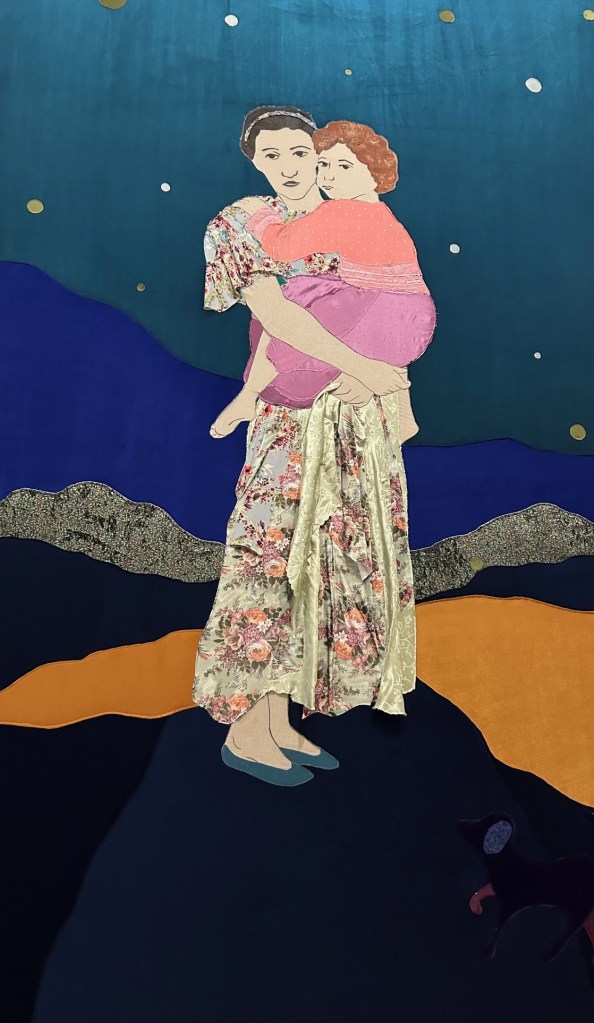
I also discovered a stunning exhibition at the Whitworth Art Gallery of textile collages by a Polish Romani visual artist, Malgorzata Mirga-Taz. Her work challenges stereotypes of the Roma peoples, particular in art history, and celebrates their strengths through adversity. Her portrait series of survivors of the Romani holocaust living in Krakow was particularly moving.
I’m very grateful to Jane for sharing her story and inspiring me to learn more about the lives and struggles of these communities.
2 thoughts on “Gypsies, Roma and Irish Travellers”
Thanks for this, Margaret. It sounds like a really thoughtful session. I’m working on Saturdays now, so cantnusially attend the Stories sessions, but I likev o keep up with what you’re doing. Thanks again. I hope you’re well. Anne
I was so sorry that i missed this session. I was very keen to come as I have worked with traveller communities in the past. but somehting cropped up on the domestic front. Thank you Jane for such a good report and Margaret for your interesting comments too. I don’t know if it is true but my father who grew up in the East End of London always said his grandmother came from an Irish Traveller community. True or not, I was always rather proud of the possibility! Although I have traced some family ancestry I have never been able to locate that part of the family in Ireland.



 The Stories of Our Lives
Thanks for this, Margaret. It sounds like a really thoughtful session. I’m working on Saturdays now, so cantnusially attend the Stories sessions, but I likev o keep up with what you’re doing. Thanks again. I hope you’re well. Anne
LikeLiked by 1 person
I was so sorry that i missed this session. I was very keen to come as I have worked with traveller communities in the past. but somehting cropped up on the domestic front. Thank you Jane for such a good report and Margaret for your interesting comments too. I don’t know if it is true but my father who grew up in the East End of London always said his grandmother came from an Irish Traveller community. True or not, I was always rather proud of the possibility! Although I have traced some family ancestry I have never been able to locate that part of the family in Ireland.
Many thanks to you both.
Jean
LikeLiked by 1 person