Hear this blog post read aloud:
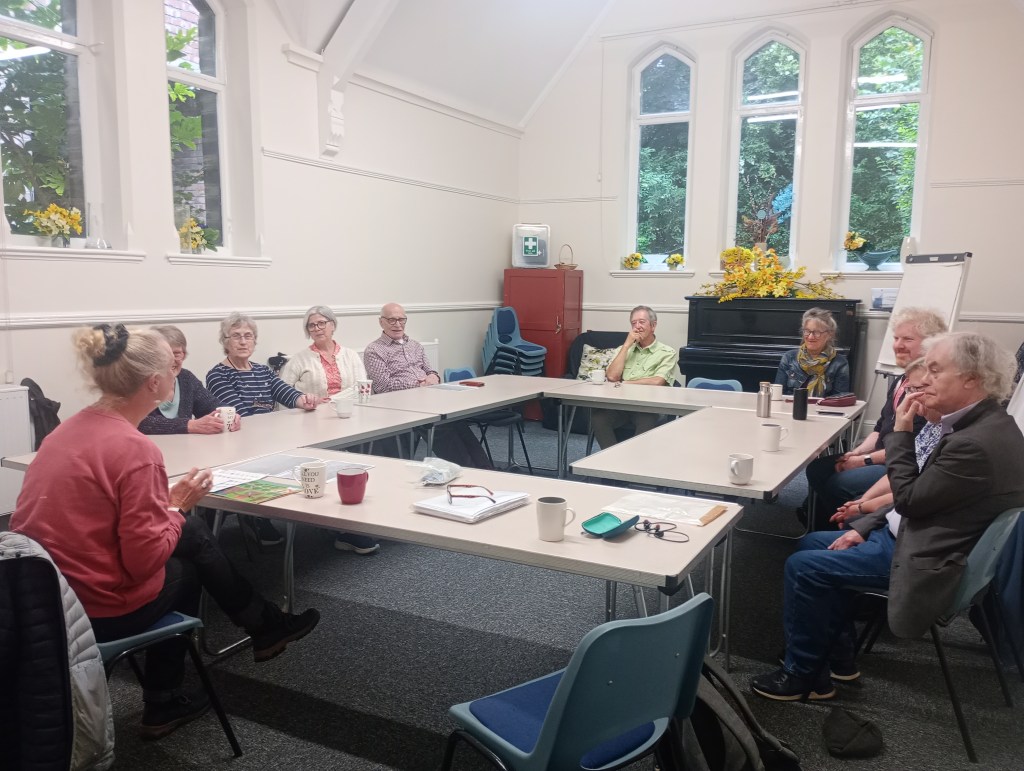
The group felt really lucky to be joined recently by our local councillor, the brilliant Tina, who shared her story of working in Deaf education for over 45 years. It all started in a café in North Manchester, where she first saw a Deaf family signing to each other across the counter. Something about that moment lit a spark that’s stayed with her ever since.
Tina’s session was warm, lively and full of connection. She got us all involved, including a brilliant activity where we had to silently organise ourselves by birth order using only intuitive sign language. Somehow, we managed it in record time… probably faster than if we’d been speaking!
She also taught us the BSL alphabet and numbers, and signed the story of Goldilocks and the Three Bears – which was completely captivating.
The whole session really got us thinking about how we connect with each other, how much we can communicate without words, and who gets included when we do things differently.
Tina’s written more about her journey in the guest post below. Read on and you’ll likely agree that it’s thoughtful, passionate, and full of heart. We’re so glad to be able to share it here.
Tina Kirwin-McGinley
In a dark kitchen in North Manchester when a spark was ignited. It was whilst watching a deaf family communicate with one another across the café counter, where I was doing a Saturday job. It was in those moments, as a teenager, watching their silent, weekly interactions, that a burning passion to learn sign language began.
Forty-five years later, after a long career in Deaf education, working principally with BSL users aged between 2 months and 22 years, my passion for sharing the joys and beauty of BSL continues! And my commitment and engagement with the Deaf population is also ongoing, as I am now a trustee and volunteer at the Manchester Deaf Centre.
Initially at university, I learnt Paget Gorman signed speech, then moved across the ocean to New York and began learning American Sign Language (ASL). ASL is a one-handed form of sign language that allows one to carry on chatting and socialising whilst eating or even enjoying a pint.
It was during my time in the USA and socialising with Deaf young people that I recognised Deaf people are a strong and vibrant community, with their own culture and language. Subsequently, I quickly learnt that Deaf people do not see deafness as a disability.
The assumption by the hearing world that sign language is a universal language is not a reality, and each country, in fact, has its own signs and different ways of fingerspelling their alphabets and numbers.
There are even regional variations in the UK, just like there are accents in English. For example, there are completely different signs for “mother” in Manchester and “mother” in Liverpool. This is because regional versions developed in small Deaf communities, long before the days of accessible travel, TV, social media and paid interpreters.
Upon returning to the UK, I began to learn BSL and the etymology of the language. Like all languages, there’s a long history to BSL, with the origins of some signed words going back hundreds of years. The sign for “biscuit”, for example, evolved from Deaf sailors working on long sea voyages, and the sign resembles a cake and the breaking of hard, lard biscuits using one’s elbow.
In the 1800s, Deaf children in Britain were taught by priests and monks, not in schools, and the religious influences can still be seen in some BSL signs. For example, the sign for “Sunday” is the same as the sign for “prayer”. And the sign for “good morning” has references to making the sign of the cross in the Catholic faith.
My understanding is that in BSL, you use whichever is your dominant hand to sign. It doesn’t make any difference to another person’s understanding if you are left- or right-hand dominant.
Facial expressions are very important; it is helpful to overcome one’s shyness and inhibition to communicate well!
Like any second language, it is important to practise and to learn new vocabulary associated with developing technologies and newly evolving concepts.
You principally use the upper half of your body to communicate in sign language. For example, the sign for “walking” is made by using two fingers to walk like legs.
It is essential for all UK political figures to have BSL interpreters in order for all members of the Deaf community to have the opportunity to play a part in shaping the UK. It is very encouraging to see the Mayor of Greater Manchester, Andy Burnham, using a BSL interpreter at events.
Sign language interpretation should be recognised as a human right for Deaf people – essential for access to the news, the arts, education, politics, medical appointments, interviews, and so much more.

 The Stories of Our Lives