Hear this blog post read aloud:
Jolene began by asking each of us for our initial one-word reactions to this theme. They were varied: “opportunities, excitement, community, family, entertainment, roots, home, connections, my birth, Windrush, permanence, memories, magnet, security, diversity, culture”.
Then she asked us to reflect, on our own, in answer to these questions:
- How do I feel about Manchester as a place to live?
- What brought me here, or what kept me here?
- Is there anything which resonates from the words other people came up with?
What an uplifting discussion was to follow, as we shared our stories about what Manchester means to us, as well as the places some of us moved from to be here. Eight of us later chose to share our responses with you in writing.
Charlotte Wright
I remember the car ride when you first decided to take me in. You were a sensitive soul and you couldn’t stand to hear the harsh criticism. I was oblivious. Water off a duck’s back.
You opened up your home to me and I was dazzled by it. A million miles from the dreary conformity of the small-town suburbs. My first introduction to Manchester life.
I remember the postcards. Bold, bright reproductions of lesbian pulp fiction covers displayed across one wall of the downstairs toilet. I remember hearing a phrase often back then (I still sometimes do): ‘I don’t mind if they’re gay as long as they don’t shove it down our throats!’ This was you shoving it down their throats. Boldly you. I admired that.
The kitchen was warm and full of herbs, spices and condiments I’d never seen or heard of. You were a brilliant but erratic cook. The kind who would spend hours concocting and use every dish and implement in the kitchen. On Sundays you would sit at the kitchen table hunched over your laptop working hard and planning for the school week ahead.
Your upstairs ‘library’ sparked envy in me but you were generous with your lending and recommendations. I discovered new favourite authors. Read of magic, war and far away countries.
My favourite room of all was the conservatory. The peace and light. Sitting and slowly sipping a cup of coffee, just watching the garden and birds outside. I made playlists and invited friends over. And occasionally wore your boxing gloves and let the punching bag have it after a bad day.
Yours is the home I will forever try to emulate in my own, though I know it will always fall short. I go away and come back but Manchester always feels like home. I wish everyone such a soft place to land in times of need.
Jane Graham
Number 58
58. Just a number? This number is attached to a house. The door of this house has a central glass panel displaying a large CND symbol in colourful stained glass. This is a Victorian house; how come it has a CND symbol in the door’s central panel? In 1968 it had a beautiful acid stain image of a beehive with bees flying around it dating back to 1878. The family that came in 1968 brought their door knocker with them, a large black iron CND symbol which had been made by a blacksmith. This looked good against the white paint of the door. Number 58 was named ANANDAVAN (peace amidst chaos). Number 58 has a large porch which shelters all the wonderful people who came up the long drive.
The bees have gone. The door knocker has gone. Why? A stone through the glass and removal of a nail meant they no longer exist. Someone did not like the message and activities of the people who lived behind the front door of 58. For over 50 years the message and activities remained the same.
The house with this number became a magnet for those who shared the desires for a peaceful world and knew they could be active to change everything that was opposed to these ideals. At various times 58 was all you needed to say and everyone knew where it was and what it meant.
The basic family of seven was always able to accommodate all who came: food, beds, benefits, awareness of issues nearby and anywhere in the world: Vietnam. Apartheid. Northern Ireland. Chile. Women’s Aid, Miners, Nuclear-free Pacific, Free School and many more, all were found actions that hopefully could change the suffering of people involved. Summer sunshine made the garden a place for music, singing, dancing. The cellar produced the leaflets to advertise the message; we also had a veggie shop there!
The creator of the life of 58 is no longer here. Number 58 is quiet now, resting, waiting.
What will happen next at 58?
Pauline Omoboye
Manchester

Wellies, umbrellas
Splashing in the puddle,
Wet and wonderful children in a huddle.
Laughter and wonderment feeling privileged in the rain
Manchester it’s pouring and here to entertain.
Rainmacs and hoodies to stop us getting wet
Pitter and patter the droplets set
Ripples on the windows dripping down the pane
Manchester predictable let’s dance in the rain.

(C) Pauline Omoboye
Tony Goulding
“What encapsulates Manchester for me?”
For a lifelong supporter of Manchester City and sport in general it may have been assumed that my answer would reference these interests in some way. This was not the case, however, as my choice was Manchester’s Central Library. To me, this iconic building constitutes both a statement of civic pride and a commitment to the promotion of education and culture generally. I am also impressed by the fact that it was constructed during the deprived conditions of the 1930s.
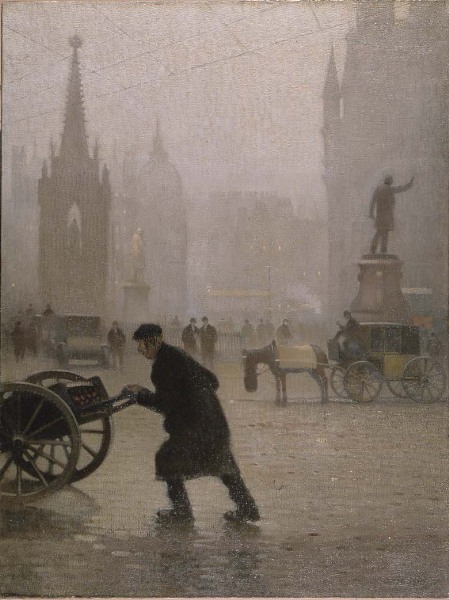
On a less tangible note, I also see inclement weather as very much a Mancunian attribute. For me, cloudy rainy days seem to display our resilience and foster a communal spirit as we are all hunching up against the rain. My favourite images of Manchester are by L. S. Lowry’s tutor, Pierre Adolphe Valette, for example, this one of Albert Square in Manchester Art Gallery’s collection.
I am also proud of Manchester’s long history as an industrial and industrious city and its pioneering rôle in both the advancement of democracy and scientific progress. The Peterloo massacre, the founding of both the first Co-op society and the Trade Union Congress, and the Pankhursts being examples of the former.
Meanwhile Manchester’s contribution to science is shown in the work undertaken in the city by John Dalton (Chemistry), Ernest Rutherford (Physics), and Alan Turing (Computer Science).
Jean Thompson
Not a Mancunian by birth but definitely a Mancunian in heart and soul.
Actually born in Middlesex, I moved to Manchester at the age of seven and quickly discovered at my new school that not everyone spoke like me. Different accent, different words even, I was a bit of a novelty. I very quickly adapted the accent and although my father was a true cockney from the East End, my mother was a Manchester girl so was able to interpret that when my teacher told us to bring in our pumps, she meant our plimsolls. That was a help!
Time went on and more and more I forgot that I had not been born in Manchester. The older I got the more I appreciated my home town, and the prouder of its heritage I became. The history, political and social, the heritage of arts and music and the rich cultural background, not to mention its proximity to beautiful countryside.
So much of a Mancunian I was that many years later when I was on a coach trip surrounded by non-Mancunians, a southern ‘wag’ said “Oh yes Manchester, with two football teams, ha ha!”. Resisting a strong urge to resort to inappropriate language I answered, “Oh, I know nothing about football (not true, my whole family were lifelong Reds). I do know about the Pankhursts and Marx and Engels writing the Communist Manifesto in Manchester and all the other history, the artists like Lowry, and music from the Halle and the Hacienda years’. Gratifyingly, he kept quiet after that.
For a period of eight years after we were married, we moved five times to different towns, but the day we moved back to Manchester was a day of celebration and jubilation. I was home.
Of course there are things about Manchester I am not keen on, some of the modern buildings for example, and it has the problems of any big conurbation. It doesn’t always get it right but I think its heart is still there. Read ‘This is the Place’ the poem about Manchester written by Tony Walsh in 2012, and read by him in 2018 at the vigil in memory of the victims of the bombing atrocity at The Manchester Arena. He says it all so much better.
Patrick Steel
I love Manchester
I came here to study some 45 years ago. And Manchester made me feel welcome. I’ve worked here to try and make it a better place for everyone. I’m now a retired member of the Royal Town Planning Institute.
Not such a bustling metropolis when I arrived. It was a dirty litter strewn city centre, which began to shut down every day soon after 5pm. I stayed the first week in the YMCA near the Midland Hotel sharing a dormitory with the homeless looking for a bed for the night. Fortunately, the university soon sorted me into a student flat. Not the salubrious purpose-built accommodation of today, I hasten to add.
In time, I found Council employment where I concerned myself with matters relating to the economic, social, and environmental welfare of the population. We used to say, “it’s grim up north!” Now we look at revival and all the regeneration.
People say, “the grass is greener on the other side.” Well in my case it really was…I had left Belfast at a time when sectarianism and strife was the norm. Someone over there told me recently that they’ve “…wised up a bit now” I grew up in a place where politicians incited violence, and bomb scares were a weekly occurrence. We had to be searched just to enter the city centre via “the ring of steel.” If you drove a car, you checked under it before setting off, and you varied your route. It wasn’t paranoia. Just common sense.
What I love about Manchester is the ethos in this place. The willingness to promote change if things don’t seem right. I’m not a historian. But there’s a rich legacy here. Pankhurst to Kinder Scout etc. Too numerous to mention. No wonder that there are so many Manchester global firsts. And it’s still full of people pushing on with change. Big shout out to Jolene with her social enterprises.
Yes, things here aren’t perfect. But they would be a lot worse if we didn’t continually try to improve the situation! Without hope for better things to come and the possibility of change, life would really be dire.
Jolene Sheehan
Why Manchester
Commuting daily from Sandbach to a teaching job in Northenden meant my first experience of Manchester was limited to work. I barely spent any time in the city itself, just enjoying meeting people at school who lived there. One of the first occasions I did venture out was a Halloween party at a friend and work colleague’s house. In her kitchen, full of good food and music, there were lots of people to chat to, but from the moment Pat walked in, I only saw him.
He was dressed as a calculator, fashioned out of a bin bag, with taped on numbers. He was radiant with fun and positive energy. I spent the rest of the party following him around, curious about what witty daftness he would come out with next. Alongside the excitement, there was an immediate sense of trust. Playful, expansiveness grounded in warmth.
We were married within the year, and I felt at home with Pat wherever we were. The decision to settle in Manchester made sense on a practical level at first, closer to both our jobs. I swapped motorway commutes for bike rides, my cycle route taking me through Chorlton Water Park, across Bailey Bridge and under the M60.
Over time, a deeper connection to Manchester took hold. I changed jobs, made new friends, had our son Caelan in 2011, built a network of mum friends, started volunteering locally, and eventually set up my social enterprise in 2019. Each change brought new connections and new ways of strengthening my roots here. Alongside that, Pat’s family lived just around the corner or a short distance away, and my mum and dad were only a 35-minute drive away.
What keeps me here is the same feeling I had that night. Manchester is full of possibility, with bubbles of newness every day. Even though my routines are set mostly in or near Chorlton, walking the same routes, especially my beloved Water Park, working from home, visiting places like ALL FM in Levenshulme or work at other community centres across Greater Manchester, I am still learning and changing all the time. Meeting new people or deepening old friendships.
I love the richness of the communities I mix with. The races, heritages, faiths and ways of living. I love how many people are active in their communities, and how many people I meet who really care.
Thinking about Manchester and what brought me here fills me with gratitude. There is so much inside me and around me to see afresh. So many layers of connection, history, possibility and serendipity. I know I will never get bored here or feel stifled. I know I will be challenged, and that I will keep changing. And I also know, quietly and surely, that this is my home, and that I belong.
Margaret Kendall
From Burnley, the route of the X43 bus climbs steeply up Manchester Road to cross dramatic moors to Rossendale, before joining the M66 motorway to Manchester. Once I bought myself a car, I carried on driving that way home to Chorlton and still prefer that scenic route when I have the time.
I remember, over forty-five years ago now, hearing the hurt in my dad’s voice on the phone when I told him I wasn’t going to apply for the librarian’s post in Nelson he’d seen advertised. Did it feel to him like a personal rejection as well as that of my small hometown, now that I’d been away for some time as a student? Maybe he believed that it was the city’s cultural life that made me choose Manchester. I couldn’t explain to him or my mum that I wanted, no I needed, to be where I could have the freedom to be me. I needed to live where I could be with other women finding alternatives to society’s expectations and to find my soulmate (I’m so lucky that I eventually did).
I’d studied in Birmingham, Lyon in France, and was just finishing my postgraduate librarianship degree in Sheffield when that phone call took place. I chose to come home to the North West, not only because I wanted to live within easy reach of my family (but not too close!), but also because of a strong sense of belonging here. Manchester was a place we visited occasionally when I was growing up and had always had an appeal to me.
It worked out fine in the end. My parents were proud of my achievements in the various stages of my career. They were always welcoming to my female partner when we joined in gatherings with my siblings and children in Burnley (where they had moved in retirement) and we hosted family parties at our house too.
South Manchester has been home for so long now that I can’t imagine leaving, but East Lancashire remains such a special place to me too. I love the variety of opportunities and diversity of our city, but my heart always quickens a little when I see the moors, valleys and get my first glimpse of Pendle Hill as I drive towards it.


 The Stories of Our Lives