Hear this blog post read aloud:
Our final Stories of Our Lives session of the year took place on 20th December at Chorlton Library. It was a really lovely one to end with as we gathered with brews, mince pies, notebooks, and put some time aside to pause and gather our together our thoughts before the year turned.
We moved through three main reflections: time spent thinking about Stories of Our Lives and community, and time reflecting on the year in a more personal sense, both looking back and looking ahead. Each reflection began with a few minutes of quiet writing or reflection, and then a wider group chat at the end.
Rather than writing about personal reflections, which are not mine to share, I will write about what surfaced in terms of community and Stories of Our Lives.
One particularly lovely and recurring theme was how people experience Stories of Our Lives as something that continues beyond the sessions themselves. Even those who have only been able to come along occasionally spoke about still feeling connected through the blog and newsletter, and through the simple fact of living locally and running into one another in everyday places. Someone described living in London for many years and knowing that feeling of anonymity and constant turnover, compared to the warmth of recognising familiar faces here and feeling part of something steady and rooted.
People spoke about how Stories of Our Lives gives a sense of belonging without obligation. You can come often or occasionally, write a lot or a little, speak or mostly listen, and still feel part of the group. For several people, this mattered deeply. It was described as a place you can return to, rather than something you have to keep up with.
There was also reflection on writing itself. Many people named how solitary writing can be, and how important it is to have a space where writing sits alongside listening, conversation, and shared curiosity. Stories of Our Lives was spoken about as a place that gently supports writing without pressure, where deadlines can help focus but are not punitive, and where a poem, a few sentences, or simply thinking something through are all equally valid.
The conversation widened into reflections on community more broadly. People spoke honestly about how fractured things can feel at the moment, and how important it is to find ways of building links between different groups of people rather than staying in separate bubbles. There was acknowledgement that fear shapes many people’s day-to-day choices in public spaces, often in ways we do not immediately see unless it is named.
Alongside this, people shared very practical examples of community care that don’t always get noticed or talked about. The support offered by the community at a local Mosque after the South Manchester floods was shared as a powerful example, with people recalling food, shelter, and kindness offered freely. There was also reflection on how communities sometimes respond to threat or harm by opening their doors wider rather than closing inwards. These moments were named by the group as reminders that care is often happening quietly, without a big fanfare.
We also talked about physical spaces, and what makes a place feel accessible. Libraries came through strongly as genuinely welcoming, neutral spaces where people feel able to come as they are. We acknowledged that many community events end up happening in pubs or churches simply because they are large buildings that exist, while also recognising that those spaces can feel like barriers for some people. It felt important to name why meeting in a library matters to Stories of Our Lives, and how place shapes who feels able to participate.
A few practical and creative threads came in too. We spoke about the display being installed in the library rotunda from 7 January, marking five years of the Stories of Our Lives blog. Margaret and Lindy have been carefully bringing together writing and photographs so that as many voices as possible are represented, including people who are no longer with us. There was appreciation for the care involved in this, and also conversation about whether smaller, changing displays through the year might allow the group to stay visible without everything resting on one big moment every few years.
Another moment that stayed with people was a very human one. Someone spoke about wanting to declutter life next year to make more time for what matters, then immediately made everyone laugh by describing how long they had spent that morning looking for their glasses. It felt like a perfect example of the tone of the group, thoughtful, honest, and able to hold seriousness and humour side by side.
There was also discussion about access. Someone suggested recording sessions or offering something for people who cannot attend in person. We talked openly about the balance there. Recording can be inclusive, but it can also make people feel self-conscious and less willing to share. It felt important to hold consent and choice at the centre, and to explore options occasionally rather than making recording the default.
When we looked ahead, the tone felt thoughtful rather than goal-driven. Words, feelings, and intentions emerged naturally, without the sense of anything needing to be fixed or final. It felt more like planting seeds than planning outcomes, a bit like burying bulbs and trusting that something will come up when it is ready, without trying to sort the whole garden at once.
This felt very aligned with the ethos of Stories of Our Lives itself. This is not a group driven by performance or productivity. We write because we want to, not because we have to. It is an invitation, and sometimes a gentle challenge, but one we can accept in our own time rather than as an obligation. The group creates space for reflection for its own sake, for thoughts to be unfinished, for ideas to take a while, and for participation to look different for different people. Many people spoke about how rare and valuable that feels.
We ended by briefly talking through the upcoming January sessions and practicalities. On 3 January, we will be gathering as a group to plan together, thinking about the next drop-in session on seasons and how we want Stories of Our Lives to feel and function going forward. Then on Saturday 17 January, we will be hosting Windows Through the Seasons, a relaxed, drop-in community session at Chorlton Library, as shown on the poster below.
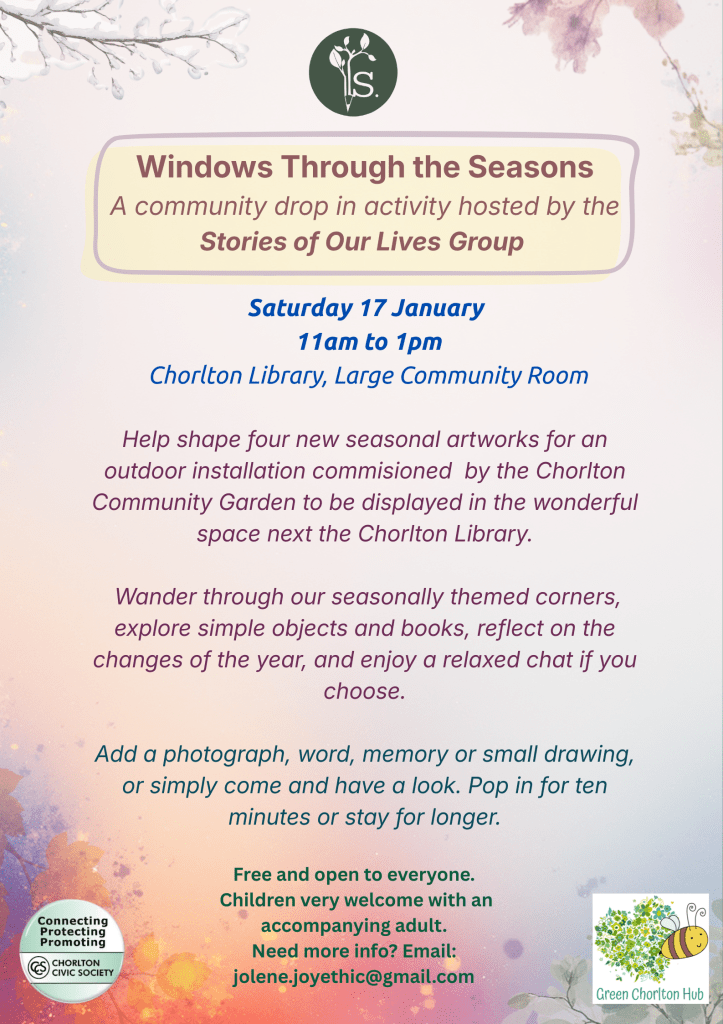
This session links to a commission I am working on for Chorlton Community Garden, creating four seasonal artworks for the outdoor space next to the library. It is open to all ages, with people invited to wander through seasonal corners, look at simple objects and books, reflect on the changing year, and, if they wish, contribute a word, memory, photograph, or small drawing. It is very much a come-and-go space. You can stay for ten minutes or much longer, and simply looking is as welcome as taking part. It runs from 11am to 1pm. The group came up with some lovely ideas for how we can make this as collaborative and interactive as possible and we are excited to share the experience with you if you can make it!
For those reading this blog post who were not at the end of December session, you might like to take a moment yourself. You could reflect on one or two of the prompts we used:
What has mattered to you this year?
Is there a moment or connection that stays with you?
As winter settles in, what would you like to carry forward?
Thank you to everyone who has been part of Stories of Our Lives this year, whether through sessions, writing, conversation, quiet presence, or simply reading the blog.
Wishing you a Merry Christmas, a Happy New Year, and all the warmth and winter cheer from the Stories of Our Lives group.

 The Stories of Our Lives
An excellent summing up of an excerllent session. The group under Jolene as facilitator is such a warm and supportive group of people. May it move into 2026 with kindness and trust as its core, as a bulwark against the challenges we face from those who choose hate.
LikeLike
Thanks Lindy for this and all you do and bring to the group. Here here to you wishes for 2026.
LikeLike