Hear this blog post read aloud:
We started off 2025 with a brilliant session led by Jean Byrne, who talked about her work with Friends of Longford Park. She demonstrated how creating a community map of groups and resources brought people together in lasting ways. Jean also reflected on how much she learned from the project, discovering the incredible contributions of so many local people and organisations.
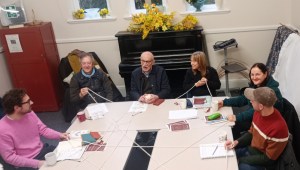
Inspired by this wonderful example, I led a follow-up session, where we shared an interactive activity using a giant web of wool to explore the different ways we’re all connected. Together, we considered how these connections are not only shaped by place but also by the histories and stories that tie us to each other over time.
Jean Byrne
Connecting with our community
As a volunteer with the Friends of Longford Park (FOLP), I had the opportunity to attend a two day residential course about a community development technique called Community Mapping. This technique involves finding out and promoting what you already have rather than dwelling on what is missing from or wrong with a community. It’s about accentuating the positives as the old song goes.
Through finding out about all of the different groups that meet in the park and the people who run them I became much more connected with my local community. It made me realise how much the welfare of society depends on the goodwill and commitment of an unseen army of volunteers. Through doing an audit of park groups Friends of Longford discovered that there are about 40 organised groups that regularly meet on the park. The vast majority of groups are organised by volunteers. This includes Longford Scouts who have existed in the park since 1912. Generations of the same families are involved in organising the Scouts. The Community Centre and Trafford Athletics Club have been mainly run on a voluntary basis since the 1970s by two generations of the same families. The Pets Corner is entirely run by volunteers who have to come in to feed the animals every day of the year.
Through doing this exercise and producing a park information leaflet and map then distributing it within the park and in the local area we have improved community connections. We held a launch event for the map in 2016, wearing tee shirts celebrating the Pet’s Corner.
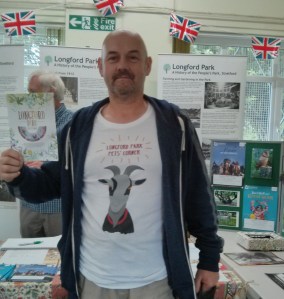
Groups within the park are now more connected with each other. For example the Community Choir sponsors a chicken at the Pets Corner and regularly sings at other groups events. Since 2016 we have had 3 reprints of the leaflet and had 10,000 copies printed each time. Most of the leaflets were given to local primary schools. The first year it was delivered to schools just before the long summer holidays to promote the park to parents who might be looking for free activities. Connections have now been established with schools and they use our map for doing geography field trips in the park.
Through being involved in this process I have learned that the most important community resource is the people who live here and what a wealthy area we live in. Not in terms of money but in people willing to give their time for free for the benefit of others.
Margaret Kendall
I used to go to Longford Park more often when we lived close by, but it remains a special place to me. When I visit, I feel connected to my past, as I remember the laughter of our foster children, nieces and nephews on visits to the play areas. It’s such a pleasure nowadays to take our great nephews there too.
In the meeting, Jolene invited us to reflect, silently, on the theme of connections for a few moments. I looked down and focused my thoughts on the attractive cover of the park leaflet and map which Jean had given to us.

“The people’s park” mosaic: lots of pieces making a whole, a symbol to me of the connections between people and nature. We need green space, the flowers and the trees. I thought about the intricate connections between flowers and wildlife, how pollen spread by bees helps the flowers and vegetables grow. I thought about the connections we have with trees, helping us to find calm through “forest bathing”, helping us breathe by removing carbon dioxide from the atmosphere. That led me to thinking about recent scientific discoveries which have shown that trees connect with one another and communicate through their roots and underground networks of fungi.
When we shared our reflections with each other, Danielle said they have now discovered that newly planted young trees thrive better when planted near older trees. Maybe they nurture their young as animals do? A lovely thought, which left me with a sense of awe about nature and how we need to cherish our connections with the natural world to which we belong. We damage it at our peril.
Sue Ash
Connections > a bunch of daffodils left outside my door > Wordsworth poem I have enjoyed from childhood > looked it up in one of my poetry books to remind me of the words > a page flipped over to reveal another Wordsworth poem “The Reverie of Poor Susan” > a city girl who day dreams of countryside when she hears the song of a Thrush > must have written for me!
The starting point for my mapping has to be family. I grew up in a large extended family and annual family get togethers became a tradition that started for my grandmother when she was widowed. Too many of us find it difficult to undertake long journeys now, so these no longer take place. Although we are very different from each other, it is the one group I feel totally ‘at home’ with. We have known each for all our lives, have many shared memories, and can just be and are accepted for who we are.
The next significant point would be having and bringing up children. Looking back on my own experience, and now watching my daughter bringing up my two grandsons. Parents need connections with other parents. As a single parent for many years, I couldn’t have managed without a system of exchanging favours with friends and neighbours with children, some of whom I still keep in touch with, albeit from a distance. From this I learnt that it is possible to form quite close and comfortable connections similar to family, drawn together by shared experiences.
In my third age I know that to make new connections and feel part of my community I need people who have similar interests and/or experiences, though not necessarily the same opinions. Moving into my flat nearly 3 years ago, the other residents seemed to keep very much to themselves, other than the usual pleasantries if we passed in the corridors. Over time conversations expanded to discussing issues with the building and we now have a WhatsApp group to keep each other informed. Then some dropped by for a cup of tea, and we started to talk about other things.
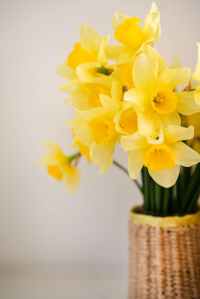
I feel I have made a connection with some neighbours as friends and was touched today when I found a bunch of daffodils left outside my front door because I was in hospital yesterday.
Tony Goulding
In a really engaging session led by Jolene the group explored our connections with each other through the creation of a giant “Cat’s Cradle”. Reflecting on this I thought of how we are all connected to one another. As it was fresh in my mind having seen it over the Christmas holiday, I saw how this is epitomised in the great film starring James Stewart, “It’s a Wonderful Life”, when Clarence, the angel, shows a suicidal George Bailey just how many people his life had touched.

Looking at my own life I saw how I personally benefitted from such interconnectivity. My joining of Chorlton Good Neighbours Gardening Group provided an introduction to their history talks which in turn became a catalyst for contributing posts for Andrew Simpson’s Chorlton History Blog. Subsequently, I discovered that Andrew and I both had ancestors who were sent to Canada as “British Home Children.” Andrew suggested I join a Facebook group “British Home Children – The View from the U.K.”.
Recently I discovered from newly released records a couple of addresses in Ontario, Canada in which one of my great uncles lived for a time in the late 1920s. Having posted my find on the group’s page I was pleasantly surprised when a very kind lady and a fellow member who lives in Ontario replied telling me she knew the area very well and would take some photographs of the houses when in the vicinity. Duly, a week or two later she sent these two photos to me. Making connections, as Jolene pointed out, not only of a wider geographical context but also, historically, across different time periods.


It would be very remiss of me not to add that it was also through the Chorlton Good Neighbours connection that I am now a part of this group, with another circle of friends who are all so supportive of each other.
Pauline Omoboye
On reflection.
In the hustle and bustle of everyday lives, it’s easy to forget the power of reflection and connection.
When we reflect, whether on our own or with others, we look back on our journeys acknowledging the highs, the lows, and the growth and challenges that have shaped us. It helps us to connect not only to ourselves, but also to the people and the world around us, building relationships that are authentic and meaningful.
When we step outside and allow nature to embrace us with its quiet beauty, we become more attuned to our inner selves. It’s in the stillness of the trees, the rhythm of the waves or the rustling of the leaves and the feeling of the grass beneath our feet, that helps us to find a moment of peace.
Grounding and reflecting remind us that, just like the natural world, we too have cycles of growth, change and renewal. It reminds us we are constantly evolving, learning and adapting. It’s humbling and it helps us to make sense of our place in this world.
Stories of Our Lives is a group that has brought out the best in me. Here we gather every fortnight in a creative, safe space bringing stories to unfold, sharing pieces of ourselves and building a community that uplifts and supports each other.
What makes these sessions so impactful is the grounding technique that Jolene brings each week. Her gentle approach guides us into the present moment. It helps us to release the hustle and bustle of the outside world. We take a breath as we share our stories.
We don’t just talk about our past, we dig deep, exploring our emotions, our struggles and our triumphs. It’s in this process of this reflection that we find the support we need within the group by sharing our writing.
We also find a space to be vulnerable, a space where our voices are heard, and our experiences are shared. The bonds formed go beyond just shared stories. They create friendships that support and nurture us inside and outside the group.
Through our shared commitment to these fortnightly sessions, it has helped us to witness the growth not just in each other, but within ourselves. We understand that the power of connection and reflection doesn’t just lie in what we give, but also in what we receive. It helps to shape who we are.
Reflection and connection create an environment where we can thrive. By coming together, grounding ourselves in the present, and sharing our stories, we create a space where this Is possible.
And I firmly believe that Stories of our Lives is that space.

 The Stories of Our Lives