Over the past 18 months, Stories of Our Lives has continued to grow. Thanks to your ideas, participation, and support from group donations, Manchester City Council, and the Amazon Literary Partnership, we’ve held more than 24 creative and reflective sessions in Chorlton, explored facinating themes and creative methods from Green Spaces and Childhood to Memoir Writing and Poetry, welcomed wonderful guest facilitators and seen members self-publish books, begin new studies, and regularly write for our blog and the Manchester Post. Our blog now reaches readers in 180 countries, with nearly 38,000 visits, and our storytelling has travelled further through a number of outreach projects and connections with other groups.
In our July 2025 feedback, participants told us they value the variety of themes and guest speakers, the safe, supportive community, the inspiration to write and create, and the gentle challenge to step outside comfort zones. Participants also say our sessions are rooted in creativity, connection, respect, openness, kindness, and a willingness to try new things. We give space for all voices and bring lightness and laughter alongside depth.
Many also said that what makes Stories of Our Lives feel so nourishing is the way we hold space for one another. Both in terms what we share, and also in how we show care for each other’s time, energy, and presence. Whether someone is participating, facilitating, or supporting behind the scenes, we try to bring thoughtfulness, mutual respect, and a sense of balance. This shared ethos is part of what keeps the group sustainable, supportive, and joyful for everyone involved.
Looking ahead, here are the plans for the future based on other feedback:
Returning to Chorlton Library from mid October for its central location, visibility for newcomers, and access to technology.
Continuing to publish session themes in advance so people can prepare or choose the ones that interest you most.
Weaving in suggested topics — local history, nature and wildlife, favourite films, brief encounters, sweet treats, photography/video for storytelling, and belief systems.
Keeping a healthy mix of guest-led and member-led sessions to bring fresh voices and perspectives.
Exploring the option of occasional online gatherings so those unable to join in person can still take part.
Encouraging punctual starts so the session’s plan and objectives are clear to everyone from the outset. If joining late, quietly check in without disrupting the flow.
Supporting first-time or occasional facilitators with encouragement and constructive feedback if they’d like it.
Respecting each other’s creative boundaries , keeping up the habit of always asking before taking photos, and never record voices, faces, or work without consent.
Mixing up conversation partners from time to time so we hear fresh perspectives and connect across the group.
Continuing to check in for feedback so the group evolves in ways that feel relevant, inspiring, and inclusive for all.
Whether you join in person or follow from afar via our blog, thank you for helping make Stories of Our Lives what it is; a living, evolving space for creativity, shared stories, and connection. Here’s to the next chapter!
The group felt really lucky to be joined recently by our local councillor, the brilliant Tina, who shared her story of working in Deaf education for over 45 years. It all started in a café in North Manchester, where she first saw a Deaf family signing to each other across the counter. Something about that moment lit a spark that’s stayed with her ever since.
Tina’s session was warm, lively and full of connection. She got us all involved, including a brilliant activity where we had to silently organise ourselves by birth order using only intuitive sign language. Somehow, we managed it in record time… probably faster than if we’d been speaking!
She also taught us the BSL alphabet and numbers, and signed the story of Goldilocks and the Three Bears – which was completely captivating.
The whole session really got us thinking about how we connect with each other, how much we can communicate without words, and who gets included when we do things differently.
Tina’s written more about her journey in the guest post below. Read on and you’ll likely agree that it’s thoughtful, passionate, and full of heart. We’re so glad to be able to share it here.
Celebrating together at Ascension Church Hulme during the Social Sunday event, highlighting birthdays and community connections.
On Sunday 6th July, we gathered at Ascension Church Hulme for a joyful, creative Social Sunday exploring the theme of Birthdays & Celebrations. The aim was to bring people of all ages together to share memories, have fun, and connect across generations.
We had a thoughtful and meaningful discussion following on from hearing Jane’s story about her involvement in supporting a group of gypsies who were being harassed. Our responses included reflections on similarities from our own experiences of feeling like an outsider, on prejudice and how it comes into all our lives, and the complexities of finding solutions.
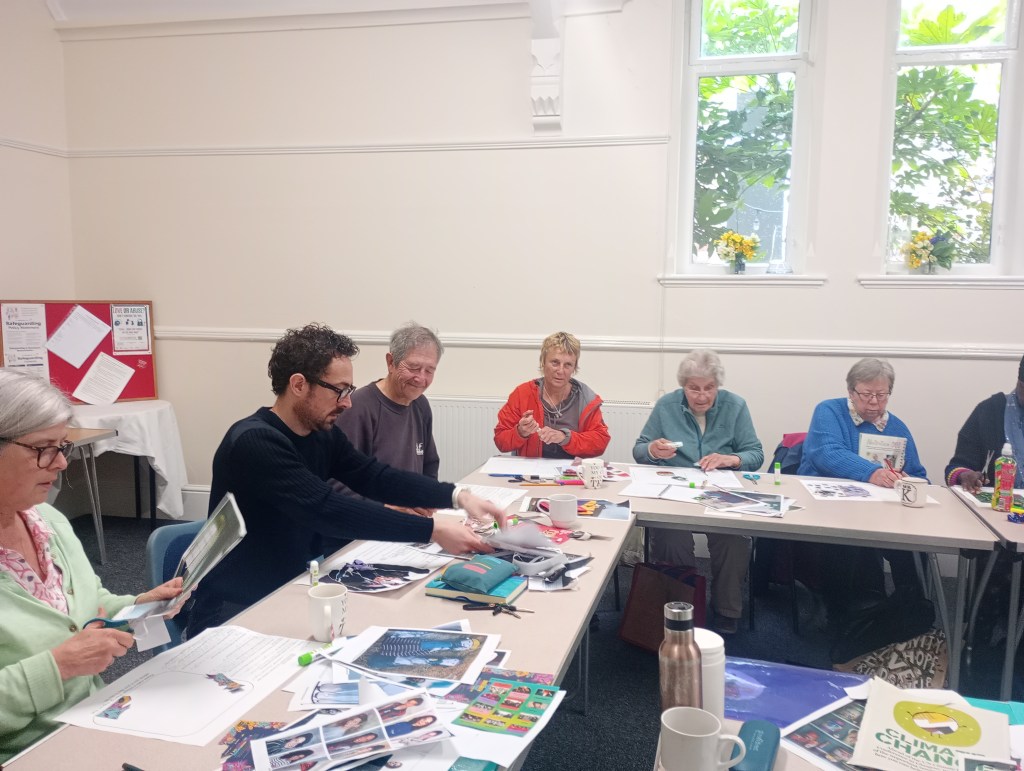
Recently, we welcomed Lesley Raven, Senior Lecturer in Fashion Art Direction, for a beautifully layered session exploring clothing, collage, and the subtle ways our identities are stitched into what we wear.
Lesley invited us to reflect on our everyday outfits. Her questions got us to think about what we like, what we don’t, what we reach for again and again and the ways we choose to express and dress ourselves at different points in our lives. Then she invited us to create a collage that represents our day-to-day selves. As we cut and stuck our images, conversation flowed naturally: warm, funny, and meandering exchanges that sparked insight and connection. We then paired up to reflect more deeply, and closed the session with a group chat, sharing a little of what we’d realised through the session.
Read on to see some of the group’s thoughts and experiences on this rich and relatable topic.
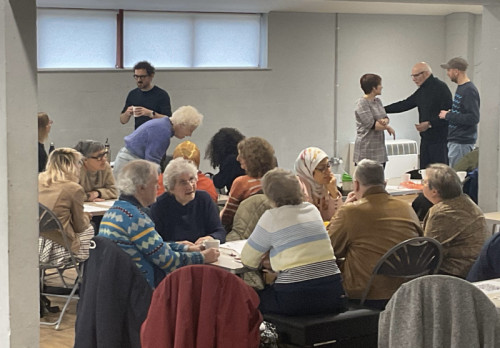
Participants engaged in a creative collage workshop reflecting on personal fashion and identity.
In our most recent session, Ben Wild introduced us to Kurt Vonnegut’s “story shapes.” Vonnegut came up with eight of these, and said that every story—from ancient fairy tales to Shakespeare to modern fiction—fits into one of them.
Ben guided us through an activity where we mapped the rise and fall of our emotions that morning, or in recent days. We used Vonnegut’s graphs as a starting point to notice how, even in a few short hours, so much can shift beneath the surface.
From this, a mix of writing emerged. Some poetic, some reflective, some playful or philosophical.
Together, they explore what it means to feel, to tell stories, and to question the patterns we’ve been taught to follow.
We enjoyed an interesting and learned talk from ‘Be(n) Wild’ of MMU on the use of emotions in storytelling. I was intrigued and so sceptical when he mentioned that a researcher, Kurt Vonnegut, postulated that there are a set amount of patterns of emotions in all stories – a conclusion he arrived at way before the invention of computers.
We were invited to try one pattern to write about our emotional state that morning. I initially chose the flatline schemata, ‘Good news or Bad news’, as I was raised as a traditional male stoic so I have difficulty relating to my emotions. Indeed, how do we even tell if events are good or bad in the present? For example, a broken leg may save you from conscription! But conscription could mean glory and incredible service. We can only evaluate fully in our last days. With gender blurred in modern society, I feel less embarrassed to give it a go and analyse my own emotions… imagine my surprise when I read it back as a rollercoaster journey.
Woke up this morning. As usual the body was stiff and painful. Sad that I ached and attributed it to the wear and tear of time. Happy to be still alive. What’s the alternative? Angry with myself that I hadn’t yet developed the discipline of daily exercises to try and slow the degeneration. Thought about my plans for the day. Afraid that I couldn’t do everything… the fear of missing out, FOMO the young ‘uns call it. Chose the workshop, but unable to do a volunteer task from 10–2 today. Disgusted that I had so little time and energy to get out the door and face the day, and accomplish all I wanted to. Delighted to meet an old friend walking on the way there. Shared our grumbles about our common ailments. Settled into our seats, with a coffee or tea, and prepared to listen to our instructions. Finally, my open mind went emotionally into neutral! Or so I thought… Oh the joys of learning!
Pauline Omoboye
Today
Today I woke up happy I could picture the day ahead Today I woke up happy as I got out of my bed My feelings are those of contentment I saw it in my dream I knew my day was mapped out in a happy scene But then I gazed up at my watch The time had gone so fast The feelings of being late came out and cast A shadow deep into my heart At the thought of what I could miss But as I entered the room Came that feeling of sheer bliss It’s going to be the day I wanted It brought to my face a smile My emotions rising to the top This feeling should last a while.
I woke up early, pleased to see the blue sky and sunshine. Downstairs, I saw the frost on the lawn and rooftops and felt somewhat anxious about our trip to the Lakes tomorrow in the camper van: how cold will it be there?! I took a cup of tea back to bed, one for me, one for my sleeping partner, read for a while and fell back into a heavy sleep. “Oh no, I’ll be late for Stories of our Lives,” I thought when she finally woke me. I got ready quickly, left the house and met a neighbour. We exchanged a few words, I hurried on, met another, then another! I felt resigned to being late, but glad to live where I do – I feel like I belong. I walked into the garden of the church and met Jane – such a lovely calm person, she explained that she couldn’t make it to the group as her daughter was taking her out for the day. Her warmth calmed me, I came through the door and felt happy to be with everyone. My late arrival didn’t matter at all, after all.
It started with some charts. As a prompt to start today’s workshop, Ben Wild brought Kurt Vonnegut’s famous model of story shapes. They showed us the rise and fall of fortune, arcs of success and failure, and a way to make experience fit a pattern: things got better, then worse, then better again.
But something felt off. It treated the protagonist’s fortune as if it existed in isolation, as if emotions and events happened in a vacuum. Yet in real life, stories aren’t just about one person moving through change. Stories are about relationships, movement, space, and time. Emotions don’t simply rise and fall; they ebb, flow, transform, stagnate, spill over. And then the idea came—what if the way we structure stories shapes how we experience emotions—and therefore, life itself?
We’ve inherited a linear way of storytelling, shaped by Greek theatre, the Enlightenment… and more recently, the news, X Factor, and advertising. These structures train us to see life as a tidy journey with clear beginnings, middles, and ends. This individualistic framework tends to fit us one of three slots—hero, villain, or victim—meaning everyone (and sometimes even everything) else has to occupy the remaining two spaces. Perfect fuel for polarisation and the prioritising of self over community, really, isn’t it?
I started wondering… maybe it’s time to expand beyond this. To explore traditions that honour cycles, interconnection, and emotional fluidity. And perhaps the next step isn’t another rigid framework at all… but permission to let stories move naturally, mirroring the world around us. Then I thought about how part of this shift might mean learning to stop seeing emotions as ‘goodies’ and ‘baddies’, and instead finding a way of welcoming them in—like Rumi suggested. And if his idea of greeting them all as friends feels too exposing, maybe we could imagine emotions as places we move through—different ways of meeting them.
Some emotions are experienced in a brightly lit room, full of hyper-awareness. Others take place in a cluttered basement, where feelings get boxed up and labelled Do Not Open. Sometimes we’re rushing through corridors, searching for a way out of feeling at all.
But as I was walking during these reflections, the idea of walls started to feel restrictive. I searched the sky for an answer, but it was too vast and formless. Then I saw a rock, steady and still. Suddenly, I heard its story: “I was once buried deep in a quarry,” the rock said. “Now I sit in the open air, where people rest their tired legs. You think I am cold, but I hold the warmth of time. I will outlast you and your family. But I will hold your stories within me.”
And that’s when I realised—I didn’t need lines or walls to plot or frame emotions or storytelling. Stories and feelings don’t just happen inside people or even rooms. They unfold in rivers, trees, skies, shifting weather, and the way light moves across water. Nature has been witnessing stories forever, without ever needing an arc or tidy resolution. A tree doesn’t fail when it loses its leaves. A river doesn’t succeed when it reaches the ocean. The sky isn’t wrong when it is filled with storms.
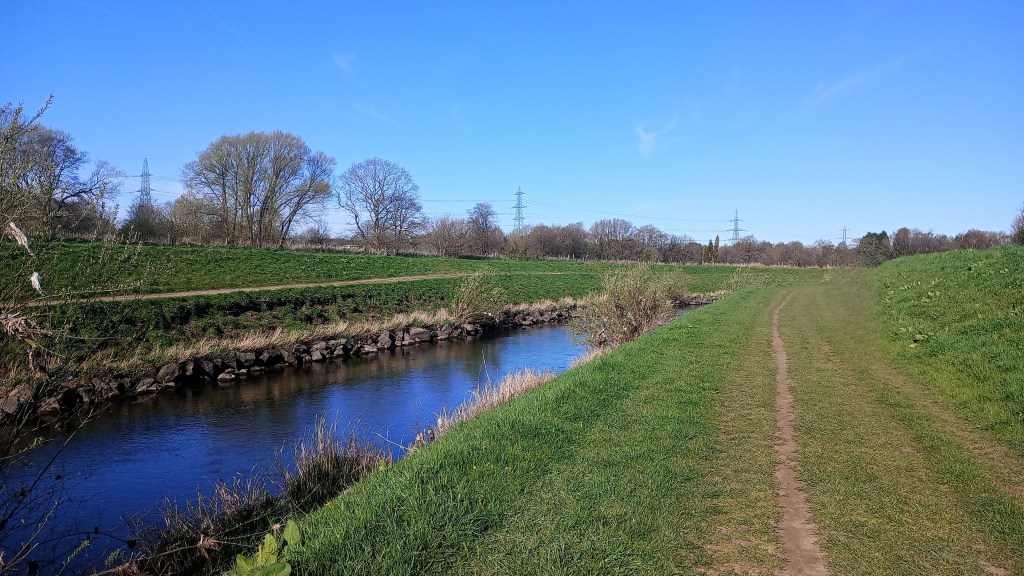
The River Mersey, Chorlton by Jolene Sheehan
Maybe if we start experiencing and then telling our stories this way—with a greater sense of interconnection and spaciousness, where we don’t need to be the main character—we realise we don’t have to force our narratives to make sense. We don’t have to stay stuck in one perspective. Instead, we can let our experiences be spacious, complex, and relational.
So here’s where I am now… My stories don’t have to be about winning or losing. They can be about movement, flow, cycles, connections. My emotions don’t have to be overcome like opponents. They can be witnessed, held, allowed to exist without urgency. Because the frameworks we use to make sense of things don’t just describe reality—they shape it. And I am ready for a different shape.
Finally, sometimes, the best thing we can do is step outside, listen, and let the landscape teach us something new.
Moments of joy were easy to recall as we went round the room: an unexpected smile from a passer-by, a memory of climbing a mountain, comfort from stroking your cat, settling down with a good novel, a warming cup of tea, the sound of a cheering football crowd, signs of Spring in the park, cuddling a toddler finally succumbing to sleep… It was a topic some had previously discussed (see Small Joys, November 2022 ) and a joy to share some pieces written then with more recent members of the group.
In a follow-on meeting, Chris Hogben led a relaxed and enjoyable sewing workshop, helping us to capture our thoughts about small joys as we chatted, stitched and unwound. In the blog post which follows, some of us share the results in images, others have also written reflections. Enjoy!
We started off 2025 with a brilliant session led by Jean Byrne, who talked about her work with Friends of Longford Park. She demonstrated how creating a community map of groups and resources brought people together in lasting ways. Jean also reflected on how much she learned from the project, discovering the incredible contributions of so many local people and organisations.
Inspired by this wonderful example, I led a follow-up session, where we shared an interactive activity using a giant web of wool to explore the different ways we’re all connected. Together, we considered how these connections are not only shaped by place but also by the histories and stories that tie us to each other over time.
As we gathered for our end-of-2024 session, we shared a wonderful time connecting with one another and reflecting on the year that has passed. It was a session filled with honesty, contemplation, and the beauty of sharing. Together, we distilled the year into key words and phrases that encapsulated our collective experiences: friends, the beauty of ordinary gentleness, challenge, chaos and disorder, annus horribilis, and perseverance. These words painted a picture of the struggles and triumphs that shaped our journeys over the last 12 months.
Looking forward, we explored the themes we hope will guide us into 2025. Words like acceptance (while seeking ways to move forward), clarity, spaciousness, facing fears, resolves, hoping for improvement, cleansing, and decluttering resonated deeply. By the end of the session, we were left feeling connected, happy, hopeful, and relaxed, with a greater sense of purpose.
Here are our writings about the year that has gone and our hopes for the future…
We enjoyed two lively meetings in November sharing our stories about an item of clothing we’d each brought with us, chosen for their special significance. There was so much to talk about! In the second session, we joined a larger group of people in an event forming part of the Being Human Festival, led by Jolene Sheehan, Professor Sophie Woodward (University of Manchester) and Doctor Benjamin Wild (Manchester Metropolitan University). A fuller description of the event and more photographs are available in a news item about the event on the University of Manchester’s web page.
Photographs courtesy of the University of Manchester
Read on to discover some of the writing inspired by the first workshop.





 The Stories of Our Lives