Windows Through the Seasons is a participatory artwork project shaped through shared reflection, creativity and connection. Local people were invited to offer thoughts, images, memories and sensory impressions connected to the seasons, contributing to a collective body of material gathered during a community event on 17th January 2026.
The project was conceived and led by me in response to a commission from Chorlton Civic Society and the Green Chorlton Hub. The contributions shared on the day will inform four final panels, created in a collage style on canvas and later reproduced onto weatherproof clear acrylic. The finished pieces will be displayed in a wooden frame at four points across the year in the community garden next to Chorlton Library, starting with Spring, revealed on Saturday 21st March at 11.30am, and then changing with each season.
Read on to see how this day of participatory creativity and connection took shape, with the wonderful ideas, energy and support of Stories of Our Lives and other key partners.
Our final Stories of Our Lives session of the year took place on 20th December at Chorlton Library. It was a really lovely one to end with as we gathered with brews, mince pies, notebooks, and put some time aside to pause and gather our together our thoughts before the year turned.
We moved through three main reflections: time spent thinking about Stories of Our Lives and community, and time reflecting on the year in a more personal sense, both looking back and looking ahead. Each reflection began with a few minutes of quiet writing or reflection, and then a wider group chat at the end.
Rather than writing about personal reflections, which are not mine to share, I will write about what surfaced in terms of community and Stories of Our Lives.
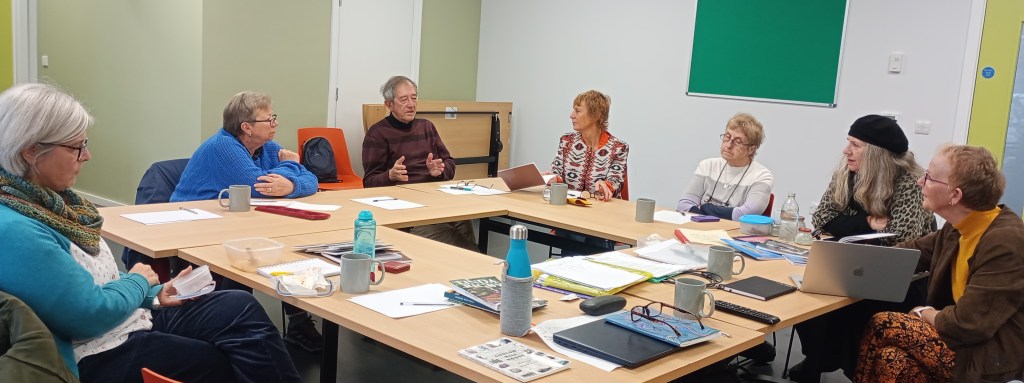
Our latest Stories of Our Lives session took place on the 18th of October at our new/ old home, Chorlton Library and was co-led by our wonderful guest speaker Merryn Myatt, who is a writer, celebrant, public speaking coach and retired journalist and broadcaster, and now runs lifestory.vip.
Participants engaging in a lively discussion during the Stories of Our Lives session at Chorlton Library, led by guest speaker Merryn Myatt.
It was an extended session today as we had so much to cover! We began by sharing our intentions for the morning. One participant used the lovely phrase “panhandler” , meaning sifting through life’s detritus for nuggets of gold. Others offered words like open, sisters, motivation, consideration, collaboration, encouragement, celebration, gentleness, and gratitude. Someone summed it up beautifully: “I can hear my critic, but I answer then with let’s get involved, let’s get curious.”
Together we reflected on our purposes for writing memoirs or life stories. These included validating our lives, showing the many sides of ourselves, and declaring with clarity and pride: there is more here than just what you see. Many spoke of wanting to leave a story behind, something that helps family and future generations see the whole person, not just what’s visible in the present. Others saw writing as a way to make sense of memory, to look back with compassion, or to celebrate what’s been achieved.
Merryn then shared examples from her work supporting people to create their own memoirs and explained her process. We discussed rhythm, method, and form, how our personal styles shape our writing journeys. I also shared a short presentation about voice transcription tools, which we’ll return to in a future session.
A big theme of the day was the power of photos, how choosing, labelling, and presenting them clearly can bring memories alive. Merryn offered practical tips on clarity, formatting, and choosing meaningful images. We even imagined creating boxes of memories, collections of photos or objects that can spark conversation and reflection, perhaps for people in care settings.
Towards the end, I reminded the group that Merryn is available for one-to-one support via merryn@lifestory.vip, and we talked about other ways to keep writing and stay connected. Many of us left with fresh motivation, one person said, “I’m remembering that I can do this.” Others planned to set aside a regular time to work on their project, even just fifteen minutes a week. Someone else said they felt newly inspired to embrace technology after the session, and another said they now want elocution lessons from Merryn because of her beautiful voice! (Merryn kindly refused, pointing out quite rightly that this request was asked by someone who has a beautiful voice of their own).
It was a gentle, purposeful, and encouraging morning and a brilliant reminder that our stories and authentic voices matter, that they’re still developing, and that sharing them can be both an act of genorosity as well as creativity and care.
It wasn’t difficult to turn back the clock to our schooldays!
We started by sharing a word or two each about our memories and/or the emotions they stirred. This resulted in a list which illustrates the variety of our responses, both positive and negative: unpredictability, learning, discovery, stickers, administration, teachers in my family, nightmare, corporal punishment, humiliation, envy, inequality, lost friends, solidarity, structure, judgement, uniforms, crowded trains and buses, a particular teacher, a flood of memories.
Joe Sykes then guided us skilfully in a time of individual reflection, using the prompts:
What experiences at school have shaped you?
What educational experiences did you have outside of school? (e.g. school trips, residentials etc.)
What happened at break time and lunch time? (e.g. sports, arts, music, drama, involvement with the local community)
He followed this by sharing his own story, illustrated by an amazing collection of photographs, scrapbooks and memorabilia from both his primary and secondary education. How wonderful to take part in the school production of the musical, Grease!
Then the room filled with noise as we discussed our responses in small groups. There was such a lot to say, no matter when we’d left school. It was fascinating to get back together at the end and hear more about one another’s experiences. Some of us tell our stories in the blog post which follows. We hope they’ll prompt memories of your own.
Our September session was beautifully led by Karen Whittick, who shared a heartfelt piece of writing to guide us in. Her words got us thinking both philosophically and personally, and set the tone for a session that felt both reflective and connecting.
We began by exploring the act of saying hello and goodbye. We talked about how in some languages the same word is used for both greeting and parting, for example aloha in Hawaiian or salut in French. In Islam the phrase as-salaamu alaykum means “peace be upon you,” with the response wa alaykum as-salaam meaning “and peace be upon you too.” This struck us as a beautiful way of not only wishing peace in both directions, but also of recognising the cyclical nature of life
From there our conversation moved into the different ways hellos and goodbyes show up in our lives. We spoke about the safety created by acknowledging someone on a hike (they might remember you afterwards if you go missing!) while others are told that its not safe to say hello. For children especially it can be confusing to be told to beware of strangers and also to be polite. We also thought about the everyday moments when a hello opens the door to respect, conversation and connection.
Our reflections then widened out into life changes ; moving home, changing jobs, the end of relationships, and the opening of new chapters. We noticed how every goodbye can carry the possibility of a hello, if we are open to it, and wondered whether that life lesson get easier with practice. How sometimes we can feel a bit stuck, while others we might flourish because we have learned to take something from the goodbye and carry it into the next chapter.
Philosophical threads ran through the whole session. We thought about the infinity symbol and how beginnings and endings are never really separate, how in Buddhism everything is interconnected and always in flux, and how nothing is ever static. At any moment there can be fullness or absence, and it is always shifting.
We touched on the whole spectrum of emotions that beginnings and endings can bring – joy, sadness, excitement, loss. Ceremonies, seasons and phases all hold that mixture. Airports and train stations came up as places where hellos and goodbyes are especially present and felt.
It was a session full of richness. There was a zooming out to the big philosophical picture and then zooming in to the specifics of our own lives.
Read on to see what our participants wrote and shared in response…
In our last Stories of Our Lives session, we turned our attention to the idea of groups – the ones we’re part of, the ones we’ve left, and the ones that have shaped us along the way. The conversation was a little shorter than usual because it was also our annual feedback session, but it was still a really rich and thoughtful exchange.
In our most recent session, Ben Wild introduced us to Kurt Vonnegut’s “story shapes.” Vonnegut came up with eight of these, and said that every story—from ancient fairy tales to Shakespeare to modern fiction—fits into one of them.
Ben guided us through an activity where we mapped the rise and fall of our emotions that morning, or in recent days. We used Vonnegut’s graphs as a starting point to notice how, even in a few short hours, so much can shift beneath the surface.
From this, a mix of writing emerged. Some poetic, some reflective, some playful or philosophical.
Together, they explore what it means to feel, to tell stories, and to question the patterns we’ve been taught to follow.
We enjoyed an interesting and learned talk from ‘Be(n) Wild’ of MMU on the use of emotions in storytelling. I was intrigued and so sceptical when he mentioned that a researcher, Kurt Vonnegut, postulated that there are a set amount of patterns of emotions in all stories – a conclusion he arrived at way before the invention of computers.
We were invited to try one pattern to write about our emotional state that morning. I initially chose the flatline schemata, ‘Good news or Bad news’, as I was raised as a traditional male stoic so I have difficulty relating to my emotions. Indeed, how do we even tell if events are good or bad in the present? For example, a broken leg may save you from conscription! But conscription could mean glory and incredible service. We can only evaluate fully in our last days. With gender blurred in modern society, I feel less embarrassed to give it a go and analyse my own emotions… imagine my surprise when I read it back as a rollercoaster journey.
Woke up this morning. As usual the body was stiff and painful. Sad that I ached and attributed it to the wear and tear of time. Happy to be still alive. What’s the alternative? Angry with myself that I hadn’t yet developed the discipline of daily exercises to try and slow the degeneration. Thought about my plans for the day. Afraid that I couldn’t do everything… the fear of missing out, FOMO the young ‘uns call it. Chose the workshop, but unable to do a volunteer task from 10–2 today. Disgusted that I had so little time and energy to get out the door and face the day, and accomplish all I wanted to. Delighted to meet an old friend walking on the way there. Shared our grumbles about our common ailments. Settled into our seats, with a coffee or tea, and prepared to listen to our instructions. Finally, my open mind went emotionally into neutral! Or so I thought… Oh the joys of learning!
Pauline Omoboye
Today
Today I woke up happy I could picture the day ahead Today I woke up happy as I got out of my bed My feelings are those of contentment I saw it in my dream I knew my day was mapped out in a happy scene But then I gazed up at my watch The time had gone so fast The feelings of being late came out and cast A shadow deep into my heart At the thought of what I could miss But as I entered the room Came that feeling of sheer bliss It’s going to be the day I wanted It brought to my face a smile My emotions rising to the top This feeling should last a while.
I woke up early, pleased to see the blue sky and sunshine. Downstairs, I saw the frost on the lawn and rooftops and felt somewhat anxious about our trip to the Lakes tomorrow in the camper van: how cold will it be there?! I took a cup of tea back to bed, one for me, one for my sleeping partner, read for a while and fell back into a heavy sleep. “Oh no, I’ll be late for Stories of our Lives,” I thought when she finally woke me. I got ready quickly, left the house and met a neighbour. We exchanged a few words, I hurried on, met another, then another! I felt resigned to being late, but glad to live where I do – I feel like I belong. I walked into the garden of the church and met Jane – such a lovely calm person, she explained that she couldn’t make it to the group as her daughter was taking her out for the day. Her warmth calmed me, I came through the door and felt happy to be with everyone. My late arrival didn’t matter at all, after all.
It started with some charts. As a prompt to start today’s workshop, Ben Wild brought Kurt Vonnegut’s famous model of story shapes. They showed us the rise and fall of fortune, arcs of success and failure, and a way to make experience fit a pattern: things got better, then worse, then better again.
But something felt off. It treated the protagonist’s fortune as if it existed in isolation, as if emotions and events happened in a vacuum. Yet in real life, stories aren’t just about one person moving through change. Stories are about relationships, movement, space, and time. Emotions don’t simply rise and fall; they ebb, flow, transform, stagnate, spill over. And then the idea came—what if the way we structure stories shapes how we experience emotions—and therefore, life itself?
We’ve inherited a linear way of storytelling, shaped by Greek theatre, the Enlightenment… and more recently, the news, X Factor, and advertising. These structures train us to see life as a tidy journey with clear beginnings, middles, and ends. This individualistic framework tends to fit us one of three slots—hero, villain, or victim—meaning everyone (and sometimes even everything) else has to occupy the remaining two spaces. Perfect fuel for polarisation and the prioritising of self over community, really, isn’t it?
I started wondering… maybe it’s time to expand beyond this. To explore traditions that honour cycles, interconnection, and emotional fluidity. And perhaps the next step isn’t another rigid framework at all… but permission to let stories move naturally, mirroring the world around us. Then I thought about how part of this shift might mean learning to stop seeing emotions as ‘goodies’ and ‘baddies’, and instead finding a way of welcoming them in—like Rumi suggested. And if his idea of greeting them all as friends feels too exposing, maybe we could imagine emotions as places we move through—different ways of meeting them.
Some emotions are experienced in a brightly lit room, full of hyper-awareness. Others take place in a cluttered basement, where feelings get boxed up and labelled Do Not Open. Sometimes we’re rushing through corridors, searching for a way out of feeling at all.
But as I was walking during these reflections, the idea of walls started to feel restrictive. I searched the sky for an answer, but it was too vast and formless. Then I saw a rock, steady and still. Suddenly, I heard its story: “I was once buried deep in a quarry,” the rock said. “Now I sit in the open air, where people rest their tired legs. You think I am cold, but I hold the warmth of time. I will outlast you and your family. But I will hold your stories within me.”
And that’s when I realised—I didn’t need lines or walls to plot or frame emotions or storytelling. Stories and feelings don’t just happen inside people or even rooms. They unfold in rivers, trees, skies, shifting weather, and the way light moves across water. Nature has been witnessing stories forever, without ever needing an arc or tidy resolution. A tree doesn’t fail when it loses its leaves. A river doesn’t succeed when it reaches the ocean. The sky isn’t wrong when it is filled with storms.
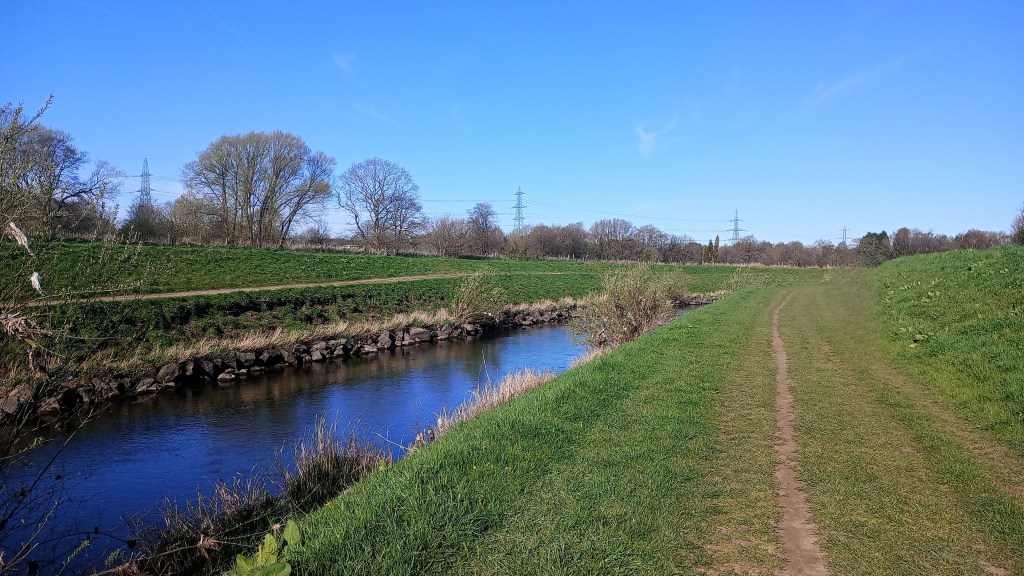
The River Mersey, Chorlton by Jolene Sheehan
Maybe if we start experiencing and then telling our stories this way—with a greater sense of interconnection and spaciousness, where we don’t need to be the main character—we realise we don’t have to force our narratives to make sense. We don’t have to stay stuck in one perspective. Instead, we can let our experiences be spacious, complex, and relational.
So here’s where I am now… My stories don’t have to be about winning or losing. They can be about movement, flow, cycles, connections. My emotions don’t have to be overcome like opponents. They can be witnessed, held, allowed to exist without urgency. Because the frameworks we use to make sense of things don’t just describe reality—they shape it. And I am ready for a different shape.
Finally, sometimes, the best thing we can do is step outside, listen, and let the landscape teach us something new.
On May 23rd, we paused from our usual storytelling and conversation format to check in with each other, find out what everyone was enjoying and wanting more of from our online group. It was a lovely meeting, where we celebrated what we had achieved together and collaborated to create ideas for the future, both in terms of themes and ways of reaching others who might benefit.
Here is some feedback gathered from the participants during this session which I have extracted from the video recording of our Zoom conversation. We would love to read about what you think of our project so far. Read to the end to find out how you can share your thoughts.






 The Stories of Our Lives