Jolene Sheehan and Anne Delargy ran this fascinating and thought-provoking session. Jean Thompson, writing afterwards, described the contents of the session so clearly that it makes an ideal introduction to this blog post:
“Who would have thought that a game of Snakes and Ladders would lead to such deep and philosophical discussion about the meaning and turning points in life?
Jolene started us off on our journey by giving us each a small tile (different for everybody) that she had painted with an image and we had to think about how this image could help us reflect on the turning points in our lives. Anne guided us through the subsequent reflection and discussion engendered by the tile, then introduced us to the game of Snakes and Ladders. Good fun as always but I don’t remember this game when played with young children ever led to such a deep discussion. But why not? It complemented perfectly the previous reflection using the tiles.
Going up ladders were the positive turning points in our lives, going down snakes the more negative ones. But can you have one without the other? How much does chance play a part in decisions and turning points? When you slide down a snake, how can you stir yourself again to get up the next ladder? ”
We hope you enjoy reading the following pieces of writing inspired by the session, including more from Jean later.
Tony Goulding
https://commons.wikimedia.org/w/index.php?curid=9273165
This topic was a very interesting one, and with the clever use of “Snakes and Ladders” boards developed into a deep and meaningful discussion. Our lives are littered with turning points. Indeed, as is amply illustrated in the 1998 film “Sliding Doors” every decision we make has the potential to be life changing.
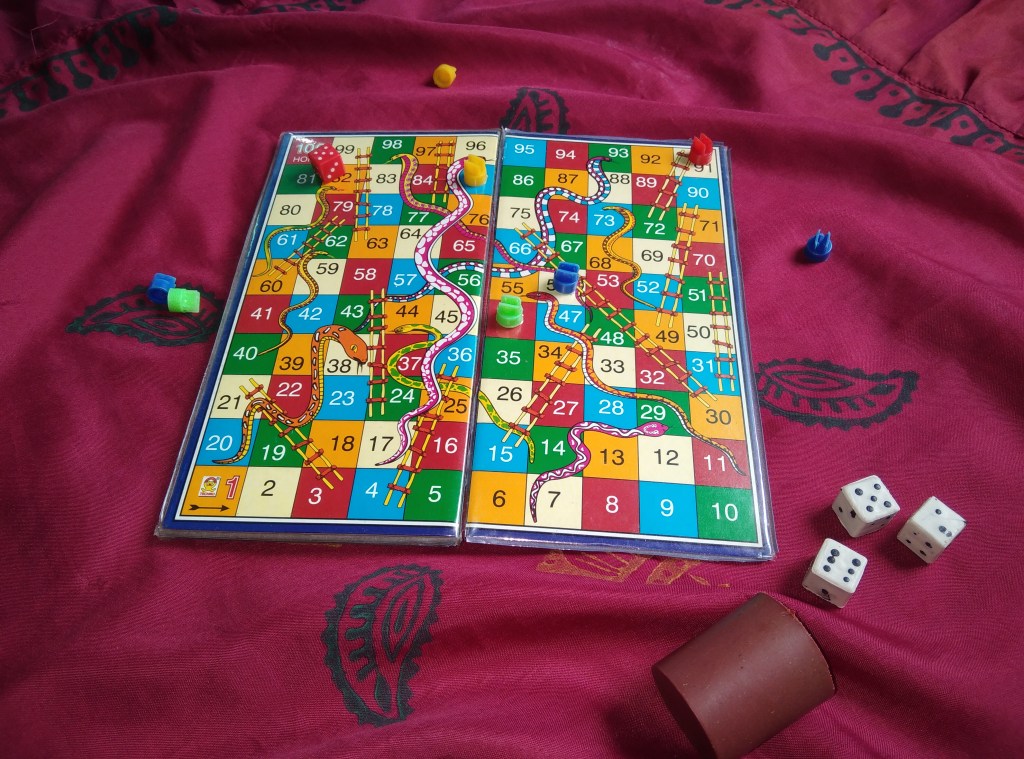
The group, while reflecting on the images on the board, produced a number of relevant points. Most obviously life’s “turning points” are just as likely to be positive ladders as negative snakes. Also, the snakes and ladders are all different sizes showing our turning points will not necessarily be major ones.
Going a little deeper it was interesting to note two other features on the board give possibly subliminal messages. Firstly, the top row when a player is close to winning has three snakes in just a few squares, gives a warning not to get complacent about your triumphs as a disaster may just be ahead of you. Secondly, the end of one of the longer snakes is only a few squares away from the games longest ladder; the message being don’t get too disheartened by a setback as a new opportunity may be just around the corner.
Margaret Kendall
Coincidentally, the week before our meeting, I’d played on a giant outdoor snakes and ladders with one of my young great nephews. It was fun to roll two giant foam dice and stand on the plastic sheet spread out on the grass as part of the National Trust’s Summer of Play activities. A couple of times I ignored him miscounting his moves to avoid going down a snake, but most of the time he didn’t cheat. He was gleeful when he genuinely got to the last square before me, after several ups and downs for both of us.
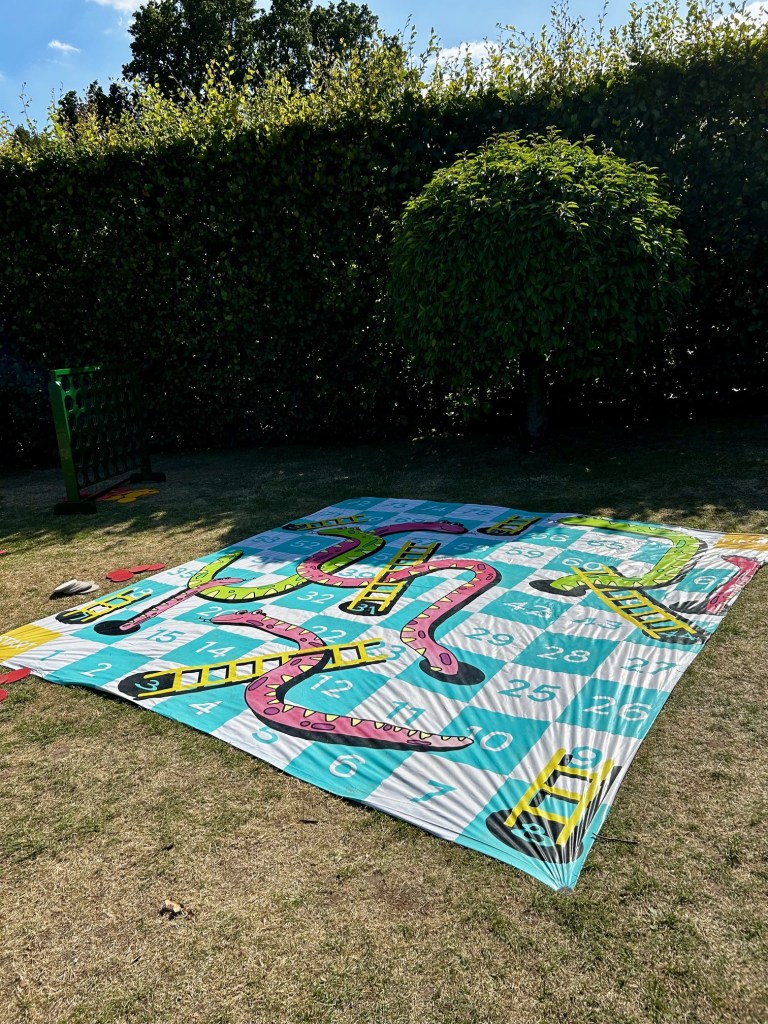
Our group had fun playing snakes and ladders too and, as Anne explained, letting ourselves play as adults can help us to relax and release our memories and emotions. In the game, you can see the snakes looming as well as the potential ladders. In life though, it’s those sudden, totally unanticipated events or experiences that can hit you the hardest and down you go, when you were thinking you were doing so well. I’ve known a few sudden turning points in my life, but the one with the most profound impact has, in fact, brought me so much happiness for almost forty years.
It was an incredible shock to get an early morning phone call from someone from the Foreign Office asking for me by name. He told me that my girlfriend had been seriously injured escaping from a hotel fire in Nicaragua, where she’d been on a study tour. Twelve people died in the fire, so she was one of the lucky ones. We had only been together for a short time before that long-planned trip. Three months of long conversations whilst she recovered in a UK hospital, with the support of all our friends and both our families, deepened our relationship in such a way that we joked afterwards that it was the likely equivalent of three years! We bought a house together the following year.
This year, we’ve celebrated the twentieth anniversary of our civil partnership and next year, we’ll have shared our lives together for forty. Here’s hoping for many more years together.
Jude Benson
It was 50 years ago today (When someone taught the band to play)
It was 1976, the year of long hot summer days.
There was a man, a good-looking man,
With an invitation to a life of lotus eating
On long white sandy beaches, surfing and sun.

There was a man, a good-looking man
I was free, I was young, I was ready to go
To long white sandy beaches, surfing and sun
But dare I? Can I? Is this my destiny?

I was young, I was free, I was ready to go
The Tarot says go, the World's your oyster
But dare I? Is this my destiny? Or is it fate?
Yes, to them all, and yes, I'm going

The Tarot says go, the World's your oyster
It's an invitation to a life of lotus eating.
The yes was loud and clear. A new start. A turning point.
1976, the year of change and long hot summer days.
Jane Graham
Turning Point
Finger point, cross roads – a small green patch with a wooden sign-post standing there, as if forever. A metaphor we are all familiar with. One arm tells where I have come from. On that day I had every intention to return there. LIFE, however, had brought me to this spot. I didn’t even think the moment could be significant, and yet, if there had been a sign-post, the arm I took would say, ‘Alternative Society’. So the next sixty five years began. Of course I know why I took it – it was due entirely to the young man leaning on his motorbike who said “We get married on Friday”. He had gone to the trouble and the expense (this was unusual) of getting a ‘special licence’.
He knew what his life’s work would be. I hadn’t a clue. Things like…’the unexamined life is not worth living…’ I learned about later. It was enough for me to be caught up in someone else’s clear vision of how life could and should be lived. His philosophy combined many things: the teachings of Karl Marx mixed with the non-violence of Gandhi; the freedom to say ‘NO’ and accept what would follow. Now we were always surrounded by like-minded people. In the 60’s, 70’s and 80’s the belief that we could create and live in a utopia of our own making was very real.
What of the road I had travelled to that moment and which I abandoned? I had come from somewhere. What of that? My boyfriend was stationed in Singapore, a pilot in the RAF. His family were expecting me to visit on my next day off. How could I turn up at the Registrar’s Office on Friday and marry someone I had known only six weeks! And he was living in a tent!
Well it worked well. For the first 30 years we engaged in many issues of social justice, set up alternative structures that met our needs. Then the sign-post read Justice for all Life. Animals, people, flora and fauna must live in harmony. Non-violence was still the tool to use. This work still continues in the hands of our wonderful son.
Now the last sign-post, only now it is broken and the pointing arm has rotted, so where it points cannot be read. There is no person to lead me. Now I look back the way I have come for the guidance I need for the impenetrable way forward.
Jean Thompson
My curiosity was piqued that such a seemingly innocent and unsophisticated game could reflect such deep considerations. It turns out this game has been a metaphor for life for many years; in fact it was popular in ancient India and was known as Moksha Patam. It reflected the traditional Hindu philosophy of Karma and Kama, (destiny and desire).
Historically too it was used in morality lessons. A player’s progression up the board represented a life journey complicated by virtues (ladders) and vices (snakes). In the past it has also been interpreted and used as a tool for teaching the effects of good deeds versus bad. Fairly obvious what was represented by what.
Reading about the background and development of this seemingly simple children’s game was fascinating. In the session, we thought we had been good at interpreting its philosophical undercurrent, but this has been done many times before, in many different ways and more comprehensively.
Certainly it was a long way from playing the game with my children to occupy them in a caravan on a wet afternoon in a damp field in Wales.
Thank you Anne and Jolene for such a fascinating and thought provoking session.


